457 posters, 2 videos, 2 audios, 8 topics, 45 sessions, 401 authors, 265 institutions
ePostersLive by SciGen Technologies S.A. All rights reserved.
49th Annual Regional Anesthesiology and Acute Pain Medicine Meeting
March 21-23, 2024 | The Hilton Bayfront San Diego | San Diego, California

5301
SOCIODEMOGRAPHIC DISPARITIES IN REGIONAL ANESTHESIA UTILIZATION FOR ARTHROPLASTY
Poster Presenter
Authors
Affiliations
Part of Topic
Scientific Abstracts > Regional Anesthesia
Sociodemographic Disparities in Regional Anesthesia Utilization for Arthroplasty
Introduction: Regional anesthesia (RA) utilization may improve outcomes, such as postoperative pain control and recovery time, and decrease complications in patients undergoing orthopedic surgeries.1 Previous studies have demonstrated race and ethnicity and gender disparities in utilization of RA, though little research has been done to investigate potential disparities based on other sociodemographic variables.2-4 The aim of this study was to identify potential disparities in RA utilization in orthopedic surgeries based on a variety of patient-level and hospital-level characteristics. Additionally, this study examined potential disparities in outcomes, including length of stay and hospital cost, between patients who received RA and those who did not receive RA.
Methods: Data were obtained from the 2016-2020 National Inpatient Sample (NIS) Database. ICD-10-PCS procedure codes were used to identify patients over 18 years of age who underwent shoulder, hip, knee, or ankle arthroplasty. Patients who received RA were then identified using additional ICD-10-PCS procedure codes. Multiple patient-level characteristics and hospital-level factors were compared between the subgroups of patients who received RA versus those who did not receive RA. Length of stay and total cost outcomes were also compared.
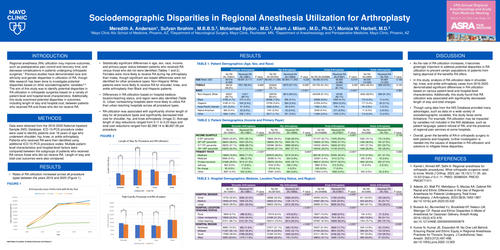
Results: Rates of RA utilization increased across all procedure types between the years 2016 and 2020 (Figure 1). Statistically significant differences in age, sex, race, income, and primary payer status between patients who received RA versus those who did not were identified (Tables 1 and 2). Females were more likely to receive RA during hip arthroplasty than males, though significant sex-based differences were not identified for other procedure types. Non-Hispanic White patients were more likely to receive RA for shoulder, knee, and ankle arthroplasty than Black and Hispanic patients. Differences in RA utilization based on hospital bedside, location/teaching status, and region were also identified (Table 3). Urban nonteaching hospitals were more likely to utilize RA than urban teaching hospitals across all procedure types. RA utilization was associated with significantly shorter length of stay for all procedure types and significantly decreased total cost for shoulder, hip, and knee arthroplasty (Image 2). Average length of stay reductions ranged from 0.11 to 0.23 days and total cost reductions ranged from $2,368.14 to $6,667.05 per procedure.
Discussion: As the rate of RA utilization increases, it becomes growingly important to address potential disparities in RA utilization to prevent certain populations of patients from being deprived of the benefits RA offers. In this study, analysis of RA utilization data in shoulder, hip, knee, and ankle arthroplasty cases from 2016-2020 demonstrated significant differences in RA utilization based on various patient-level and hospital-level characteristics. Additionally, this study found that RA utilization was associated with significantly decreased length of stay and total charges. Though using data from the NIS Database provided many advantages, such as data on a wide variety of sociodemographic variables, this study faces some limitations. For example, RA utilization may be impacted by variables not included in the NIS database, such as patient language, patient refusal of RA, and the presence of regional pain services at some hospitals. Overall, given the benefits of RA in orthopedic surgery to both patients and hospitals, further investigation is needed into the causes of disparities in RA utilization and solutions to mitigate these disparities.
References:
1. Kamel I, Ahmed MF, Sethi A. Regional anesthesia for orthopedic procedures: What orthopedic surgeons need to know. World J Orthop. 2022 Jan 18;13(1):11-35. doi:10.5312/wjo.v13.i1.11. PMID: 35096534; PMCID: PMC8771411.
2. Adeola JO, Wall PV, Mehdipour S, Macias AA, Gabriel RA. Racial and Ethnic Differences in the Use of Regional Anesthesia for Patients Undergoing Total Knee Arthroplasty. J Arthroplasty. 2023;38(9):1663-1667. doi:10.1016/j.arth.2023.03.032
3. Butwick AJ, Blumenfeld YJ, Brookfield KF, Nelson LM, Weiniger CF. Racial and Ethnic Disparities in Mode of Anesthesia for Cesarean Delivery. Anesth Analg. 2016;122(2):472-479. doi:10.1213/ANE.0000000000000679
4. Kumar N, Kumar JE, Essandoh M. No One Left Behind: Ensuring Racial and Ethnic Equity in Regional Anesthesia Practices for Thoracic Surgery. J Cardiothorac Vasc Anesth. 2023;37(3):497-498. doi:10.1053/j.jvca.2022.12.003