457 posters, 2 videos, 2 audios, 8 topics, 45 sessions, 401 authors, 265 institutions
ePostersLive by SciGen Technologies S.A. All rights reserved.
49th Annual Regional Anesthesiology and Acute Pain Medicine Meeting
March 21-23, 2024 | The Hilton Bayfront San Diego | San Diego, California

5159
DISPARITIES IN NEURAXIAL ANESTHESIA ADMINISTRATION BASED ON PRIMARY SPOKEN LANGUAGE OF HIP FRACTURE PATIENTS
Poster Presenter
Authors
Part of Topic
Scientific Abstracts > Regional Anesthesia
Disparities In Neuraxial Anesthesia Administration Based on Primary Spoken Language of Hip Fracture Patients
PRESENTER:
Jashvant Poeran, MD PhD
BACKGROUND:
METHODS
Design: Retrospective Cohort Study
Data Set: 2016 – 2023 Mount Sinai health system database
Surgical subtypes:
Variables: Primary spoken language was categorized
as: English, Spanish, and other non-English.
Statistical Analysis: Mixed-effects logistic regression evaluated the association between patients’ primary spoken language and NA (versus general anesthesia) use, adjusting for sociodemographic and clinical factors. We report adjusted odds ratios (OR) and 95% confidence intervals (CIs). Statistical significance is determined at p<.05
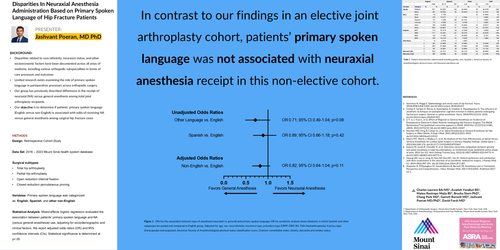
In contrast to our findings in an elective joint arthroplasty cohort, patients’ primary spoken language was not associated with neuraxial anesthesia receipt in this non-elective cohort.
Figure 1. ORs for the association between type of anesthesia (neuraxial vs. general) and primary spoken language. OR for sensitivity analysis shown (bottom), in which Spanish and other subgroups are pooled and compared to English group. Adjusted for age, sex, race/ethnicity, insurance type, procedure type (CRPP, ORIF/IM, THA Hemiarthroplasty), fracture type (intracapsular/extracapsular), American Society of Anesthesiologists physical status classification score, Charlson comorbidity index, obesity, dementia and smoker status
Table 1. Patient characteristics (abbreviated) including gender, race, hospital, ), American Society of Anesthesiologists physical status, and Neuraxial anesthesia use
REFERENCES
Charles Laurore BA/MS1, Avanish Yendluri BS1, Mateo Restrepo Mejia BS1, Brocha Stern PhD1, Chang Park MD2, Garrett Burnett MD2, Jashvant Poeran MD/PhD1, David Forsh MD1
1 Department of Orthopaedic Surgery, Mount Sinai Health System, New York, New York, USA
2 Department of Anesthesiology, Perioperative and Pain Medicine, Mount Sinai Health System, New York, New York, USA