457 posters, 2 videos, 2 audios, 8 topics, 45 sessions, 401 authors, 265 institutions
ePostersLive by SciGen Technologies S.A. All rights reserved.
49th Annual Regional Anesthesiology and Acute Pain Medicine Meeting
March 21-23, 2024 | The Hilton Bayfront San Diego | San Diego, California

5111
EFFICACY OF FASCIAL PLANE BLOCKS IN MEDICAL PLEUROSCOPY
Poster Presenter
Authors
Affiliations
Part of Topic
Scientific Abstracts > Regional Anesthesia
Title:
Efficacy of Fascial Plane Blocks in Medical Pleuroscopy
Authors:
Elizabeth Luebbert, DO
- Icahn School of Medicine at Mount Sinai; Department of Anesthesiology and Perioperative Medicine
Poonam Pai B.H MS, MD
- Icahn School of Medicine at Mount Sinai; Department of Anesthesiology and Perioperative Medicine
Ghislaine C. Echevarria MD, MS
- Icahn School of Medicine at Mount Sinai; Department of Anesthesiology and Perioperative Medicine
Udit Chaddha, MBBS
- Icahn School of Medicine at Mount Sinai; Division of Pulmonary, Critical Care and Sleep Medicine
Bertin Salguero, MD
- Icahn School of Medicine at Mount Sinai; Division of Pulmonary, Critical Care and Sleep Medicine
Greta Joy, MD
- Icahn School of Medicine at Mount Sinai; Division of Pulmonary, Critical Care and Sleep Medicine
Eden Gelman, MD
- Icahn School of Medicine at Mount Sinai; Department of Anesthesiology and Perioperative Medicine
Keywords:
pleuroscopy, medical thoracoscopy, erector spinae plane block, anterior serratus block, interventional pulmonology
Abstract:
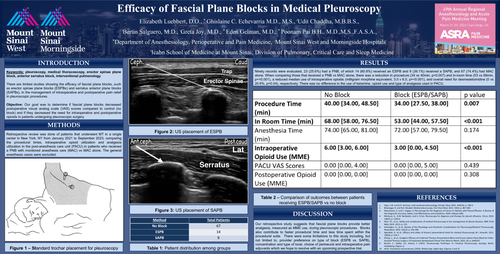
There are limited studies showing the efficacy of fascial plane blocks, such as erector spinae plane blocks (ESPBs) and serratus anterior plane blocks (SAPBs), in the management of intraoperative and postoperative pain relief in pleuroscopic procedures.
Objective:
Our goal was to determine if fascial plane blocks decreased postoperative visual analog scale (VAS) scores compared to control (no block) and if they decreased the need for intraoperative and postoperative opioids in patients undergoing pleuroscopic surgery.
Methods:
Retrospective review was done of patients that underwent medical pleuroscopy in a single center in New York, NY from January 2021 to September 2023, comparing the procedural times, intraoperative opioid utilization and analgesia utilization in the post-anesthesia care unit (PACU) in patients who received a peripheral nerve block (PNB) with monitored anesthesia care (MAC) verse MAC alone. The general anesthesia cases were excluded.
Results:
Ninety records were evaluated, 23 (25.6%) had a PNB, of which 14 (60.8%) received an ESPB and 9 (39.1%) received a SAPB[RM1] , and 67 (74.4%) had MAC alone (Table 1). When comparing those that received a PNB vs MAC alone, there was a reduction in procedure (34 vs 40min, p=0.007) and in-room time (53 vs 68min, p=<0.001), a reduced median use of intraoperative opioids (milligram morphine equivalent, 3.0 v 6.0, p=<0.001), and overall need for dexmedetomidine (0 vs 20.9%, p=0.04), respectively. There was no difference in the use of ketamine, opioid use and type of analgesia used in PACU (Table 2).
[RM1]Both previously defined
Conclusions:
Our retrospective study suggests that fascial plane blocks provide better analgesia, measured as MME use, during pleuroscopic procedures. Blocks also contribute to faster procedural time and less time spent within the procedural suite. There were some limitations to this study including, but not limited to, provider preference on type of block (ESPB vs. SAPB), concentration and type of local, choice of perineural and intraoperative pain adjuvants which we hope to resolve with an upcoming prospective trial.
References
1. Seijo, L.M. and D.H. Sterman, Interventional pulmonology. N Engl J Med, 2001. 344(10): p. 740-9.
2. Bhatnagar, R. and N.A. Maskell, Medical pleuroscopy. Clin Chest Med, 2013. 34(3): p. 487-500.
3. Manoharan, A. and C. Argaez, in Pleuroscopy for the Diagnosis of Cancer in Patients with Pleural Effusion: A Review of the Diagnostic Accuracy, Safety, Cost-Effectiveness and Guidelines. 2020: Ottawa (ON).
4. Michaud, G., D.M. Berkowitz, and A. Ernst, Pleuroscopy for diagnosis and therapy for pleural effusions.Chest, 2010. 138(5): p. 1242-6.
5. Wan, Y.Y., et al., Safety and complications of medical thoracoscopy in the management of pleural diseases. BMC Pulm Med, 2019. 19(1): p. 125.
6. Kostroglou, A., et al., Review of the Physiology and Anesthetic Considerations for Pleuroscopy/Medical Thoracoscopy. Respiration, 2022. 101(2): p. 195-209.
7. Agnoletti, V., et al., Efficacy and safety of thoracic paravertebral block for medical thoracoscopy. Br J Anaesth, 2011. 106(6): p. 916-7.
8. Zhang, L., et al., Analgesic Efficacy of Combined Thoracic Paravertebral Block and Erector Spinae Plane Block for Video-Assisted Thoracic Surgery: A Prospective Randomized Clinical Trial. Med Sci Monit, 2023. 29: p. e940247.