457 posters, 2 videos, 2 audios, 8 topics, 45 sessions, 401 authors, 265 institutions
ePostersLive by SciGen Technologies S.A. All rights reserved.
49th Annual Regional Anesthesiology and Acute Pain Medicine Meeting
March 21-23, 2024 | The Hilton Bayfront San Diego | San Diego, California

5081
RETROSPECTIVE EVALUATION OF THE EFFECT OF ADDING DEXAMETHASONE AS AN ADJUVANTTO ESPB ONPOSTOPERATIVE PAIN IN LUMBAR SURGERY CASES.
Poster Presenter
Authors
Affiliations
Part of Topic
Scientific Abstracts > Regional Anesthesia
RETROSPECTIVE EVALUATION OF THE EFFECT OF ADDING DEXAMETHASONE AS AN ADJUVANT TO ESPB ON POSTOPERATIVE PAIN IN LUMBAR SURGERY CASES.
Buse Kozlu M.D., Tayfun Aydn M.D. Kutahya Health Scence Unversty, TURKEY
ABSTRACT
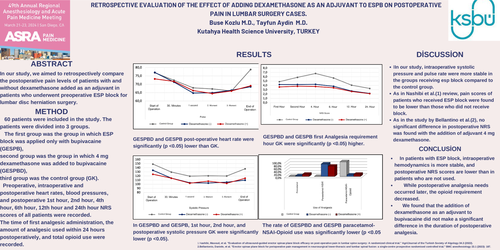
In our study, we aimed to retrospectively compare the postoperative pain levels of patients with and without dexamethasone added as an adjuvant in patients who underwent preoperative ESP block for lumbar disc herniation surgery.
METHOD
60 patients were included in the study. The
patients were divided into 3 groups.
The first group was the group in which ESP
block was applied only with bupivacaine (GESPB),
second group was the group in which 4 mg dexamethasone was added to bupivacaine (GESPBD),
third group was the control group (GK). Preoperative, intraoperative and
postoperative heart rates, blood pressures, and postoperative 1st hour, 2nd hour, 4th hour, 6th hour, 12th hour and 24th hour NRS scores of all patients were recorded.
The time of first analgesic administration, the amount of analgesic used within 24 hours postoperatively, and total opioid use were recorded.
GESPBD and GESPB post-operative heart rate were significantly (p <0.05) lower than GK.
In GESPBD and GESPB, 1st hour, 2nd hour, and postoperative systolic pressure GK were significantly lower (p <0.05).
GESPBD and GESPB first Analgesia requirement hour GK were significantly (p <0.05) higher.
DİSCUSSİON
IIn our study, intraoperative systolic pressure and pulse rate were more stable in the groups receiving esp block compared to the control group.
As in Nashibi et al.(1) review, pain scores of patients who received ESP block were found to be lower than those who did not receive block.
As in the study by Bellantino et al.(2), no significant difference in postoperative NRS was found with the addition of adjuvant 4 mg dexamethasone.
CONCLUSİON
In patients with ESP block, intraoperative hemodynamics is more stable, and postoperative NRS scores are lower than in patients who are not used.
While postoperative analgesia needs occurred later, the opioid requirement decreased.
We found that the addition of dexamethasone as an adjuvant to bupivacaine did not make a significant difference in the duration of postoperative analgesia.
RETROSPECTIVE EVALUATION OF THE EFFECT OF ADDING DEXAMETHASONE AS AN ADJUVANT TO ESPB ON POSTOPERATIVE PAIN IN LUMBAR SURGERY CASES.
Buse Kozlu M.D., Tayfun Aydn M.D. Kutahya Health Scence Unversty, TURKEY
RESULTS
The rate of GESPBD and GESPB paracetamol- NSAI-Opioid use was significantly lower (p <0.05
1.Nashibi, Masoud, et al. "Evaluation of ultrasound-guided erector spinae plane block efficacy on post-operative pain in lumbar spine surgery: A randomized clinical trial." Agri/Journal of the Turkish Society of Algology 34.3 (2022).
2.Bellantonio, Daniele, et al. "Erector spinae plane block for perioperative pain management in neurosurgical lower-thoracic and lumbar spinal fusion: a single-centre prospective randomised controlled trial." BMC anesthesiology 23.1 (2023): 187.