457 posters, 2 videos, 2 audios, 8 topics, 45 sessions, 401 authors, 265 institutions
ePostersLive by SciGen Technologies S.A. All rights reserved.
49th Annual Regional Anesthesiology and Acute Pain Medicine Meeting
March 21-23, 2024 | The Hilton Bayfront San Diego | San Diego, California

5648
REGIONAL ANESTHESIA FOR PERIOPERATIVE MANAGEMENT OF SUBCUTANEOUS IMPLANTABLE CARDIOVERTER-DEFIBRILLATOR INSERTION
Poster Presenter
Authors
Affiliations
Part of Topic
Scientific Abstracts > Regional Anesthesia
Regional Anesthesia for Perioperative Management of Subcutaneous Implantable Cardioverter-Defibrillator Insertion
Sylvie Polsky MD, Alexander Stone MD, Andrew Shorten MD, Kamen Vlassakov MD
Department of Anesthesiology, Perioperative and Pain Medicine, Brigham and Women’s Hospital, Boston, MA
Background
• The subcutaneous implantable cardioverter-defibrillator (S-ICD) is an alternative to the transvenous implantable cardioverter-defibrillator (TV-ICD) for patients who do not require pacing.
• Advantages of the S-ICD include a lower risk of infection and lower risk of lead-related and vascular complications.1
• Implantation of the S-ICD requires more extensive tissue dissection and tunneling of a lead.2
• S-ICD placement can result in significant postoperative pain and some patients require overnight admission for pain control.
• Many are performed under general anesthesia however several regional anesthetic techniques have also been employed.2
• Regional anesthesia for S-ICD placement requires coverage of the left anterolateral chest wall for the generator pocket and the left parasternal region for tunneling of the electrode.2
Methods
• Retrospective review of patients who received nerve blocks for S-ICD implantation 4/2021-10/2023.
• Primary outcomes were pain scores and opioid requirements in the first 24 hours post-procedure and hospital length of stay.
S-ICD regional anesthesia protocol:
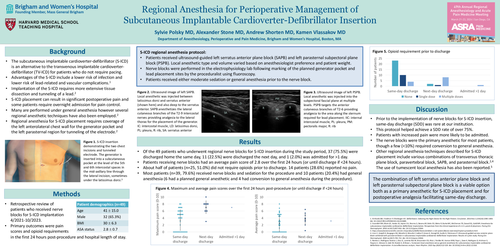
• Patients received ultrasound-guided left serratus anterior plane block (SAPB) and left parasternal subpectoral plane block (PSPB). Local anesthetic type and volume varied based on anesthesiologist preference and patient weight.
• Nerve blocks were performed in the electrophysiology lab following marking of the planned generator pocket and lead placement sites by the proceduralist using fluoroscopy.
• Patients received either moderate sedation or general anesthesia prior to the nerve block.
Results
• Of the 49 patients who underwent regional nerve blocks for S-ICD insertion during the study period, 37 (75.5%) were discharged home the same day, 11 (22.5%) were discharged the next day, and 1 (2.0%) was admitted for >1 day.
• Patients receiving nerve blocks had an average pain score of 2.8 over the first 24 hours (or until discharge if <24 hours).
• About half of patients (n=25, 51.0%) did not require opioids prior to discharge. 14 patients (28.6%) reported no pain.
• Most patients (n=39, 79.6%) received nerve blocks and sedation for the procedure and 10 patients (20.4%) had general anesthesia (6 had a planned general anesthetic and 4 had conversion to general anesthesia during the procedure).
Discussion
• Prior to the implementation of nerve blocks for S-ICD insertion, same-day discharge (SDD) was rare at our institution.
• This protocol helped achieve a SDD rate of over 75%.
• Patients with increased pain were more likely to be admitted.
• The nerve blocks were the primary anesthetic for most patients, though a few (<10%) required conversion to general anesthesia.
• Other regional anesthesia techniques described for S-ICD placement include various combinations of transversus thoracic plane block, paravertebral block, SAPB, and parasternal block.2,4 The use of tumescent local anesthesia has also been reported.5
Conclusion
• The combination of left serratus anterior plane block and left parasternal subpectoral plane block is a viable option both as a primary anesthetic for S-ICD placement and for postoperative analgesia facilitating same-day discharge.
References
1. Al-Khatib SM, Friedman P, Ellenbogen KA. Defibrillators: Selecting the Right Device for the Right Patient. Circulation. 2016 Nov 1;134(18):1390-1404. doi: 10.1161/CIRCULATIONAHA.116.021889.
2. Essandoh MK, Mark GE, Aasbo JD, Joyner CA, Sharma S, Decena BF, Bolin ED, Weiss R, Burke MC, McClernon TR, Daoud EG, Gold MR. Anesthesia for subcutaneous implantable cardioverter-defibrillator implantation: Perspectives from the clinical experience of a U.S. panel of physicians. Pacing Clin Electrophysiol. 2018 Jul;41(7):807-816. doi: 10.1111/pace.13364.
3. https://www.bostonscientific.com/en-US/products/defibrillators/emblem-s-icd-system/device-overview/implant-procedure.html
4. Uran C, Giojelli A, Borgogna DA, Morello G, Marullo F, Iodice P, Greco A, Accogli M, Guido A, Palmisano P. Ultrasound-guided serratus anterior plane block combined with parasternal block in subcutaneous implantable cardioverter defibrillator implantation: Results of a pilot study. Pacing Clin Electrophysiol. 2020 Jul;43(7):705-712. doi: 10.1111/pace.13944.
5. Romero J, Rodriguez-Taveras J, Diaz JC, Lorente-Ros M, Braunstein ED, Alviz I, Parides M, Haroun MW, Papa L, Dave K, Rodriguez D, Krishnan S, Toquica C, Velasco A, Gabr M, Natale A, Di Biase L. Tumescent local anesthesia versus general anesthesia for subcutaneous implantable cardioverter-defibrillator implantation: A cost-effectiveness analysis. Heart Rhythm. 2023 Apr;20(4):522-529. doi: 10.1016/j.hrthm.2022.12.018.