457 posters, 2 videos, 2 audios, 8 topics, 45 sessions, 401 authors, 265 institutions
ePostersLive by SciGen Technologies S.A. All rights reserved.
49th Annual Regional Anesthesiology and Acute Pain Medicine Meeting
March 21-23, 2024 | The Hilton Bayfront San Diego | San Diego, California

5597
MAXIMUM INSPIRATORY PRESSURE AS A PREDICTOR OF POST-OPERATIVE BREATHLESSNESS IN OBESE PATIENTS RECEIVING INTERSCALENE BLOCKS
Poster Presenter
Authors
Affiliations
Part of Topic
Scientific Abstracts > Regional Anesthesia
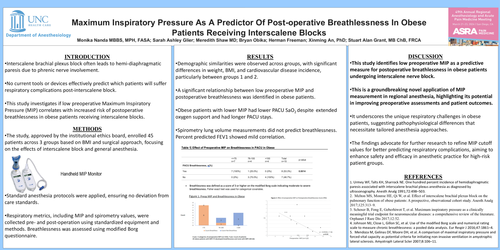
Maximum Inspiratory Pressure As A Predictor Of Post-operative Breathlessness In Obese Patients Receiving Interscalene Blocks
INTRODUCTION
•Interscalene brachial plexus block often leads to hemi-diaphragmatic
paresis due to phrenic nerve involvement.
•No current tools or devices effectively predict which patients will suffer
respiratory complications post-interscalene block.
•This study investigates if low preoperative Maximum Inspiratory
Pressure (MIP) correlates with increased risk of postoperative
breathlessness in obese patients receiving interscalene blocks.
METHODS
•The study, approved by the institutional ethics board, enrolled 45
patients across 3 groups based on BMI and surgical approach, focusing
on the effects of interscalene block and general anesthesia.
Standard anesthesia protocols were applied, ensuring no deviation from
care standards.
•Respiratory metrics, including MIP and spirometry values, were
collected pre- and post-operation using standardized equipment and
methods. Breathlessness was assessed using modified Borg
questionnaire.
RESULTS
•Demographic similarities were observed across groups, with significant
differences in weight, BMI, and cardiovascular disease incidence,
particularly between groups 1 and 2.
•A significant relationship between low preoperative MIP and
postoperative breathlessness was identified in obese patients.
•Obese patients with lower MIP had lower PACU SaO2 despite extended
oxygen support and had longer PACU stays.
•Spirometry lung volume measurements did not predict breathlessness.
Percent predicted FEV1 showed mild correlation.
DISCUSSION
•This study identifies low preoperative MIP as a predictive
measure for postoperative breathlessness in obese patients
undergoing interscalene nerve block.
•This is a groundbreaking novel application of MIP
measurement in regional anesthesia, highlighting its potential
in improving preoperative assessments and patient outcomes.
•It underscores the unique respiratory challenges in obese
patients, suggesting pathophysiological differences that
necessitate tailored anesthesia approaches.
•The findings advocate for further research to refine MIP cutoff
values for better predicting respiratory complications, aiming to
enhance safety and efficacy in anesthetic practice for high-risk
patient groups.