457 posters, 2 videos, 2 audios, 8 topics, 45 sessions, 401 authors, 265 institutions
ePostersLive by SciGen Technologies S.A. All rights reserved.
49th Annual Regional Anesthesiology and Acute Pain Medicine Meeting
March 21-23, 2024 | The Hilton Bayfront San Diego | San Diego, California

5524
PERIPHERAL NERVE BLOCKS IN PEDIATRIC CHARCOT-MARIE-TOOTH PATIENTS: A CASE SERIES AND EXPERT POSITIONS
Poster Presenter
Authors
Affiliations
Part of Topic
Scientific Abstracts > Regional Anesthesia
Peripheral Nerve Blocks in Pediatric Charcot-Marie-Tooth Patients: a Case Series and Expert Positions
Derek Smith MD, Megan Quinn MD, Lilinete Polsunas MD, Stephanie J. Pan, MD, James Xie MD
Department of Anesthesiology, Perioperative, and Pain Medicine
Stanford University School of Medicine, USA
Background
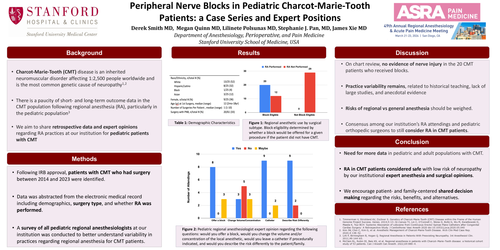
•Charcot-Marie-Tooth (CMT) disease is an inherited neuromuscular disorder affecting 1:2,500 people worldwide and is the most common genetic cause of neuropathy1,2
•
•There is a paucity of short- and long-term outcome data in the CMT population following regional anesthesia (RA), particularly in the pediatric population3
•
•We aim to share retrospective data and expert opinions regarding RA practices at our institution for pediatric patients with CMT
Methods
•Following IRB approval, patients with CMT who had surgery between 2014 and 2023 were identified.
•
•Data was abstracted from the electronic medical record including demographics, surgery type, and whether RA was performed.
•
•A survey of all pediatric regional anesthesiologists at our institution was conducted to better understand variability in practices regarding regional anesthesia for CMT patients.
Discussion
•On chart review, no evidence of nerve injury in the 20 CMT patients who received blocks.
•
•Practice variability remains, related to historical teaching, lack of large studies, and anecdotal evidence
•
•Risks of regional vs general anesthesia should be weighed.
•
•Consensus among our institution’s RA attendings and pediatric orthopedic surgeons to still consider RA in CMT patients.