457 posters, 2 videos, 2 audios, 8 topics, 45 sessions, 401 authors, 265 institutions
ePostersLive by SciGen Technologies S.A. All rights reserved.
49th Annual Regional Anesthesiology and Acute Pain Medicine Meeting
March 21-23, 2024 | The Hilton Bayfront San Diego | San Diego, California

5518
COMBINATION OF SHORT AND LONG-ACTING LA VS. LONG-ACTING LA FOR BRACHIAL PLEXUS BLOCK: SYSTEMATIC REVIEW AND META-ANALYSIS OF RCTS
Poster Presenter
Authors
Affiliations
Part of Topic
Scientific Abstracts > Regional Anesthesia
Combination of short and long-acting LA vs. long-acting LA for brachial plexus block: Systematic review and meta-analysis of RCTs
Carla R Hightower, Adeeb Oweidat, Nada Sadek, Melinda S Seering, Vishal Uppal, Hari Kalagara, Chris Childs,, Rakesh V Sondekoppam
INTRODUCTION
- Clinicians often combine short-acting and long-acting local anesthetics (LA), expecting a faster onset of blockade.
- A critical appraisal of the evidence of the benefits of LA combinations has not been performed.
- Primary objective: Compare mixtures of short and long-acting LAs vs. single long-acting LA for brachial plexus blocks in terms of onset, duration of block, and duration of analgesia.
METHODS
• Systematic review of literature performed primarily in Embase, PubMed and Cochrane databases.(Timeline: Inception to February 2023)
• 10 RCTs included in meta-analysis of pooled data
RESULTS
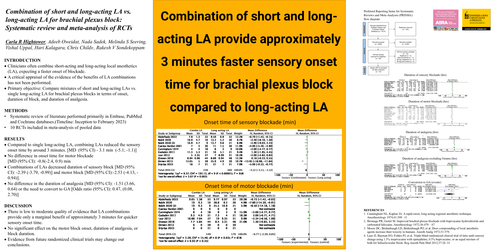
- Compared to single long-acting LA, combining LAs reduced the sensory onset time by around 3 minutes. [MD (95% CI) - 3.1 min (-5.1; -1.1)]
- No difference in onset time for motor blockade
[MD (95% CI): -0.8(-2.4, 0.9) min - Combinations of LAs decreased duration of sensory block [MD (95% CI): -2.39 (-3.79, -0.99)] and motor block [MD (95% CI):-2.53 (-4.13, -0.94)].
- No difference in the duration of analgesia [MD (95% CI): -1.51 (3.66, 0.64) or the need to convert to GA [Odds ratio (95% CI): 0.47, (0.08, 2.70)]
DISCUSSION
- There is low to moderate quality of evidence that LA combinations provide only a marginal benefit of approximately 3 minutes for quicker sensory onset time.
- No significant effect on the motor block onset, duration of analgesia, or block duration.
Evidence from future randomized clinical trials may change our conclusions.
REFERENCES
- Cunningham NL, Kaplan JA. A rapid-onset, long-acting regional anesthetic technique. Anesthesiology 1974;41:509 –11
- Bromage PR, Gertel M. Improved brachial plexus blockade with bupivacaine hydrochloride and carbonated lidocaine. Anesthesiology 1972;36:479 – 87
- Moore DC, Bridenbaugh LD, Bridenbaugh PO, et al. Does compounding of local anesthetic agents increase their toxicity in humans. Anesth Analg 1972;51:579.
- Laur JJ, Bayman EO, Foldes PJ, et al. Triple-blind randomized clinical trial of time until sensory change using 1.5% mepivacaine with epinephrine, 0.5% bupivacaine, or an equal mixture of both for Infraclavicular block. Reg Anesth Pain Med 2012;37:28–33