457 posters, 2 videos, 2 audios, 8 topics, 45 sessions, 401 authors, 265 institutions
ePostersLive by SciGen Technologies S.A. All rights reserved.
49th Annual Regional Anesthesiology and Acute Pain Medicine Meeting
March 21-23, 2024 | The Hilton Bayfront San Diego | San Diego, California

5413
CONTINUOUS EXTERNAL OBLIQUE INTERCOSTAL CATHETERS VS CONTINUOUS TAP CATHETERS IN PARTIAL HEPATECTOMIES: A RETROSPECTIVE ANALYSIS
Poster Presenter
Authors
Affiliations
Part of Topic
Scientific Abstracts > Regional Anesthesia
Continuous External Oblique Intercostal Catheters vs Continuous TAP Catheters in Partial Hepatectomies: A Retrospective Analysis
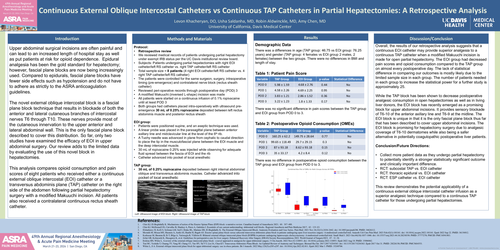
Upper abdominal surgical incisions are often painful and can lead to an increased length of hospital stay as well as put patients at risk for opioid dependence. Epidural analgesia has been the gold standard for hepatectomy; however, fascial plane blocks are now being increasingly used. Compared to epidurals, fascial plane blocks have fewer side effects such as hypotension and do not have to adhere as strictly to the ASRA anticoagulation guidelines.
The novel external oblique intercostal block is a fascial plane block technique that results in blockade of both the anterior and lateral cutaneous branches of intercostal nerves T6 through T10. These nerves provide most of the cutaneous innervation to the upper anterior and lateral abdominal wall. This is the only fascial plane block described to cover this distribution. So far, only two studies have examined the efficacy of EOI in upper abdominal surgery. Our review adds to the limited data by evaluating the use of this novel block in hepatectomies.
This analysis compares opioid consumption and pain scores of eight patients who received either a continuous external oblique intercostal (EOI) catheter or a transversus abdominis plane (TAP) catheter on the right side of the abdomen following partial hepatectomy surgery with a modified Makuuchi incision. All patients also received a contralateral continuous rectus sheath catheter.