457 posters, 2 videos, 2 audios, 8 topics, 45 sessions, 401 authors, 265 institutions
ePostersLive by SciGen Technologies S.A. All rights reserved.
49th Annual Regional Anesthesiology and Acute Pain Medicine Meeting
March 21-23, 2024 | The Hilton Bayfront San Diego | San Diego, California

5263
EFFECT OF THE INTERSCALENE AND SUPRACLAVICULAR BLOCKS ON THE C4 DERMATOME
Poster Presenter
Authors
Affiliations
UPMC, University of Pittsburgh Medical Center, Pittsburgh, PA
Part of Topic
Scientific Abstracts > Regional Anesthesia
Effect of the Interscalene and Supraclavicular Blocks on the C4 Dermatome
Yue Qiu MD†, Chelsea Cady MD†, Bedda Rosario-Rivera BS, MPH, PhD *, and Steven Orebaugh MD†
† Department of Anesthesiology and Perioperative Medicine, University of Pittsburgh Medical Center, Pittsburgh, PA
* University of Pittsburgh
ABSTRACT
Background
Anesthesia of the C4 dermatome is important for shoulder surgery, especially arthroscopic. The presumption that C4 is “covered” with interscalene block (ISB) dates back to the original description [1]. The use of ultrasound as a standard of care for performing peripheral nerve blocks has led to lower volumes of injectate with a more reliable effect. Furthermore, a number of studies reflect that supraclavicular block can be utilized for shoulder surgery with less effect on the diaphragm [2]. The actual effect of lower-volume ISB and of the SCB on the C4 dermatome has not been reported.
This prospective, single-center study examined the effects of ultrasound-guided interscalene block (ISB) and supraclavicular block (SCB) on the C4 sensory dermatome in patients undergoing shoulder, hand, or wrist surgery.
Method
This prospective, observational, single-center study, which was approved by the Institutional Review Board (IRB, STUDY22040053), examined the effects of ultrasound-guided ISB and SCB on the C4 dermatome in patients undergoing shoulder, hand, or wrist surgery. Patients undergoing outpatient shoulder, hand, or wrist surgeries received ultrasound-guided ISB (for shoulder surgeries) with 12–15 ml of 0.5% bupivacaine or ultrasound-guided SCB (for hand and wrist surgeries) 20-24 ml of 0.5% bupivacaine. We assess the effect of these nerve blocks by using a “sensory score,” which reflects overall sensation, with 0-2 points each awarded for cold and 0-2 points for sharp sensation, a overall score less than 2 reflects successful sensory block while as score of 2 or 3 reflect partial block. A baseline sensory score establishes that the patient has normal perception before block and the evaluation is repeated at 20 minutes after block is completed.
The primary objective was to investigate the sensory effect on the C4 dermatome after ISB and SCB. The secondary outcomes included the sensory effect on the C5 dermatome after performing ISB and SCB, pain scores upon arrival at the post-anesthesia care unit (PACU), and the incidence of adverse effects. We hypothesize that 80% of patients after ISB and 40% of patients after SCB will experience a sensory score <2 at the C4 dermatome.
Results
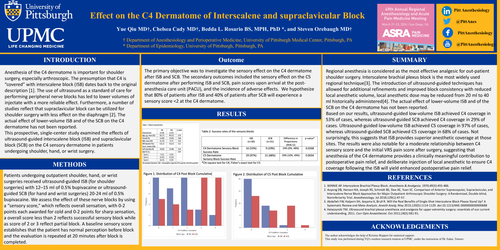
Sixty patients have been recruited: 30 for ISB and 30 for SCB(Table 1). The primary outcome, C4 dermatome anesthesia, was successfully achieved in 53% of patients after ISB and 29% of patients after SCB. A difference in proportions of approximately 24% (p = 0.0268) was observed in the C4 dermatome, indicating that successful blockade of sensation of ISB in the C4 dermatome was greater than that of SCB. While this supports our hypothesis that the anesthetic effect on this region would be higher with ISB than SCB, it fell short of the 80% effect that we predicted. A difference in proportions of 29% (p = 0.0034) was observed in the C5 dermatome, indicating that ISB had a higher success rate than SCB (Table 2). A moderate correlation (0.047) was observed between C4 sensory scores and postoperative pain.
Discussion
Regional anesthesia is considered as the most effective analgesic for out-patient shoulder surgery. Interscalene brachial plexus block is the most widely used regional technique[3]. The introduction of ultrasound-guided techniques has allowed for additional refinements and improved block consistency with reduced local anesthetic volume, local anesthetic dose may be reduced from 20 ml to 40 ml historically administered[4]. The actual effect of lower-volume ISB and of the SCB on the C4 dermatome has not been reported.
Based on our results, ultrasound-guided low-volume ISB achieved C4 coverage in 53% of cases, whereas ultrasound-guided SCB achieved C4 coverage in 29% of cases. Ultrasound-guided low-volume ISB achieved C5 coverage in 97% of cases, whereas ultrasound-guided SCB achieved C5 coverage in 68% of cases. Not surprisingly, this suggests that ISB provides superior anesthetic coverage at those sites. The results were also notable for a moderate relationship between C4 sensory score and the initial VRS pain score after surgery, suggesting that anesthesia of the C4 dermatome provides a clinically meaningful contribution to postoperative pain relief, and deliberate injection of local anesthetic to ensure C4 coverage following the ISB will yield enhanced postoperative pain relief.
Referrences
- WINNIE AP. Interscalene Brachial Plexus Block. Anesthesia & Analgesia. 1970;49(3):455-466.
- Auyong DB, Hanson NA, Joseph RS, Schmidt BE, Slee AE, Yuan SC. Comparison of Anterior Suprascapular, Supraclavicular, and Interscalene Nerve Block Approaches for Major Outpatient Arthroscopic Shoulder Surgery: A Randomized, Double-blind, Noninferiority Trial. Anesthesiology. Jul 2018;129(1):47-57.
- Abdallah FW, Halpern SH, Aoyama K, Brull R. Will the Real Benefits of Single-Shot Interscalene Block Please Stand Up? A Systematic Review and Meta-Analysis. Anesth Analg. May 2015;120(5):1114-1129. doi:10.1213/ANE.0000000000000688
- Halaszynski TM. Ultrasound brachial plexus anesthesia and analgesia for upper extremity surgery: essentials of our current understanding, 2011. Curr Opin Anaesthesiol. Oct 2011;24(5):581-91.