457 posters, 2 videos, 2 audios, 8 topics, 45 sessions, 401 authors, 265 institutions
ePostersLive by SciGen Technologies S.A. All rights reserved.
49th Annual Regional Anesthesiology and Acute Pain Medicine Meeting
March 21-23, 2024 | The Hilton Bayfront San Diego | San Diego, California

5155
DO NERVE BLOCKS IMPACT THE TIMING OF FASCIOTOMY FOLLOWING SURGICAL REPAIR OF LOWER LEG FRACTURE; A NATIONAL DATABASE ANALYSIS
Poster Presenter
Authors
Affiliations
Part of Topic
Scientific Abstracts > Regional Anesthesia
Do Nerve Blocks Impact the Timing of Fasciotomy Following Surgical Repair of Lower Leg Fracture; a National Database Analysis
〖"Alexander B. Stone MD" 〗^1, 〖"Alex Illescas MPH" 〗^2, 〖"Haoyan Zhong MPA" 〗^2, 〖"Jashvant Poeran MD PhD" 〗^3, 〖"Jeremy T. Smith MD" 〗^4, 〖"Stavros G. Memtsoudis MD PhD MBA" 〗^2,5,6, 〖"Jiabin Liu MD PhD" 〗^2,5
Introduction
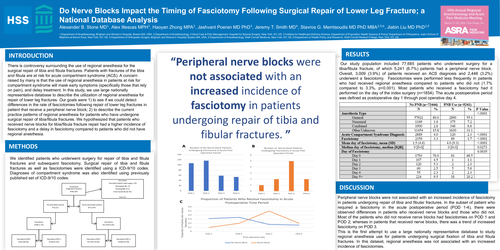
There is controversy surrounding the use of regional anesthesia for the surgical repair of tibia and fibula fractures. Patients with fractures of the tibia and fibula are at risk for acute compartment syndrome (ACS). A concern raised by many is that the use of regional anesthesia in patients at risk for compartment syndrome will mask early symptoms (specifically those that rely on pain), and delay treatment. In this study, we use large nationally representative database to describe the utilization of regional anesthesia for repair of lower leg fractures. Our goals were 1) to see if we could detect differences in the rate of fasciotomies following repair of lower leg fractures in patient that receive a peripheral nerve block; 2) to describe the current practice patterns of regional anesthesia for patients who have undergone surgical repair of tibia/fibula fractures. We hypothesized that patients who received nerve blocks for tibia/fibula fracture repair had a higher incidence of fasciotomy and a delay in fasciotomy compared to patients who did not have regional anesthesia.
Methods
We identified patients who underwent surgery for repair of tibia and fibula fractures and subsequent fasciotomy. Surgical repair of tibia and fibula fractures as well as fasciotomies were identified using a ICD-9/10 codes. Diagnoses of compartment syndrome was also identified using previously published set of ICD-9/10 codes.
Discussion
Peripheral nerve blocks were not associated with an increased incidence of fasciotomy in patients undergoing repair of tibia and fibular fractures. In the subset of patient who required a fasciotomy in the acute postoperative period (POD 1-4), there were observed differences in patients who received nerve blocks and those who did not. Most of the patients who did not receive nerve blocks had fasciotomies on POD 1 and POD 2; whereas in patients that received nerve blocks, there was a trend of increased fasciotomy on POD 3.
This is the first attempt to use a large nationally representative database to study regional anesthesia use for patients undergoing surgical fixation of tibia and fibula fractures. In this dataset, regional anesthesia was not associated with an increased incidence of fasciotomies.