457 posters, 2 videos, 2 audios, 8 topics, 45 sessions, 401 authors, 265 institutions
ePostersLive by SciGen Technologies S.A. All rights reserved.
49th Annual Regional Anesthesiology and Acute Pain Medicine Meeting
March 21-23, 2024 | The Hilton Bayfront San Diego | San Diego, California

5632
RAISING THE ROOF AND OUTCOMES: PARAVERTEBRAL BLOCKADE IN MYOCARDIAL BRIDGE UNROOFING, A 10-YEAR EXPERIENCE
Poster Presenter
Authors
Affiliations
Part of Topic
Scientific Abstracts > Regional Anesthesia
Raising the roof and outcome: Paravertebral blockade in myocardial bridge unroofing, a 10-year experience
Deeble CJ, Kasimova K, Chen J, Horn JL, Tsui BCH, Boyd J, Boublik J
Stanford University School of Medicine, USA
Background:
Myocardial bridges occur when ventricular myocardium overlies and envelops an epicardial coronary artery, and symptomatic patients may require surgery with either a thoracotomy or sternotomy approach, with or without cardiopulmonary bypass1.
Patients receiving thoracotomies2 or sternotomies3,4 have an incidence of chronic pain 1 year from surgery of up to 25-60% and 25-56% respectively.
Paravertebral blocks (PVBs) have been previous described as effective for pain control with sternotomies5 and thoracotomies.2
Aims:
Primary: Effect of PVB on length of stay (LOS) in patients with symptomatic myocardial bridges undergoing surgery.
Secondary: Effect of PVB on Pain scores and opioid use.
Methods:
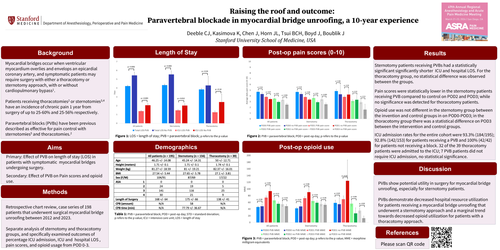
Retrospective chart review, case series of 198 patients that underwent surgical myocardial bridge unroofing between 2012 and 2023.
Separate analysis of sternotomy and thoracotomy groups, and specifically examined outcomes of percentage ICU admission, ICU and hospital LOS , pain scores, and opioid usage from POD 0-3.
Results:
Sternotomy patients receiving PVBs had a statistically significant significantly shorter ICU and hospital LOS. For the thoracotomy group, no statistical difference was observed between the groups.
Pain scores were statistically lower in the sternotomy patients receiving PVB compared to control on POD2 and POD3; while no significance was detected for thoracotomy patients.
Opioid use was not different in the sternotomy group between the invention and control groups in on POD0-POD3; in the thoracotomy group there was a statistical difference on POD3 between the intervention and control groups.
ICU admission rates for the entire cohort were 93.3% (184/195); 92.8% (142/153) for patients receiving a PVB and 100% (42/42) for patients not receiving a block. 32 of the 39 thoracotomy patients were admitted to the ICU; 7 PVB patients did not require ICU admission, no statistical significance.
Discussion:
PVBs show potential utility in surgery for myocardial bridge unroofing, especially for sternotomy patients.
PVBs demonstrate decreased hospital resource utilization for patients receiving a myocardial bridge unroofing that underwent a sternotomy approach and a marginal trend towards decreased opioid utilization for patients with a thoracotomy approach.