457 posters, 2 videos, 2 audios, 8 topics, 45 sessions, 401 authors, 265 institutions
ePostersLive by SciGen Technologies S.A. All rights reserved.
49th Annual Regional Anesthesiology and Acute Pain Medicine Meeting
March 21-23, 2024 | The Hilton Bayfront San Diego | San Diego, California

5570
USE OF AN AXILLARY BRACHIAL PLEXUS BLOCK TO RELEASE A CATHETER SHEATH FROM VASOSPASTIC RADIAL ARTERY AFTER NEUROANGIO INTERVENTION
Poster Presenter
Part of Topic
Scientific Abstracts > Regional Anesthesia
INTRODUCTION
Radial artery access has become a preferred option in various procedures due to its advantages over femoral access. However, the challenge of complications associated with the radial artery persists, often attributed to its small diameter. Among these complications, radial artery spasm is one of the most common. While prophylactic treatment with calcium channel blockers, nitrates, or a combination of both is commonly employed, some cases prove resistant to standard therapies.
This abstract introduces a novel approach to managing radial artery complications, specifically the use of an axillary brachial plexus block. The successful application of this technique underscores the evolving landscape of medical practices and the exploration of unconventional solutions for established challenges in clinical scenarios.
CASE PRESENTATION
52-year-old African American female with a medical history of RA, fibromyalgia, and obesity presented to the emergency department with a severe onset of symptoms including headache, nausea, vomiting, diaphoresis, and right-sided neck pain. The workup revealed a cisternal subarachnoid hemorrhage (SAH).
An emergent cerebral angiogram was performed to assess potential neurovascular causes Post-procedure, the patient was transferred to the Neuro-ICU in an awake, alert, and oriented state. However, three days later, her neurological condition deteriorated exhibiting extensor posturing in bilateral upper extremities and weak corneal reflexes indicative of cerebral vasospasm, the patient returned to the neuroangiography suite for further intervention.
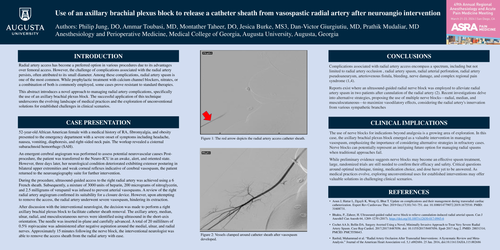
During the procedure, ultrasound-guided access to the right radial artery was achieved using a 6 French sheath. Subsequently, a mixture of 3000 units of heparin, 200 micrograms of nitroglycerin, and 2.5 milligrams of verapamil was infused to prevent arterial vasospasms. A review of the right radial artery angiogram confirmed its suitability for a closure device. However, upon attempting to remove the access, the radial artery underwent severe vasospasm, hindering its extraction.
After discussion with the interventional neurologist, the decision was made to perform a right axillary brachial plexus block to facilitate catheter sheath removal. The axillary artery, median, ulnar, radial, and musculocutaneous nerves were identified using ultrasound in the short-axis orientation. The needle was inserted in-plane and carefully advanced. A total of 20 milliliters of 0.5% ropivacaine was administered after negative aspiration around the medial, ulnar, and radial nerves. Approximately 15 minutes following the nerve block, the interventional neurologist was able to remove the access sheath from the radial artery with ease.
CONCLUSIONS
Complications associated with radial artery access encompass a spectrum, including but not limited to radial artery occlusion , radial artery spasm, radial arterial perforation, radial artery pseudoaneurysm, arteriovenous fistula, bleeding, nerve damage, and complex regional pain syndrome (1,4).
Reports exist where an ultrasound-guided radial nerve block was employed to alleviate radial artery spasm in two patients after cannulation of the radial artery (2). Recent investigations delve into alternative strategies, proposing the use of multiple nerve blocks—radial, median, and musculocutaneous—to maximize vasodilatory effects, considering the radial artery's innervation from various sympathetic branches
CLINICAL IMPLICATIONS
The use of nerve blocks for indications beyond analgesia is a growing area of exploration. In this case, the axillary brachial plexus block emerged as a valuable intervention in managing vasospasm, emphasizing the importance of considering alternative strategies in refractory cases. Nerve blocks can potentially represent an intriguing future option for managing radial spasms when traditional approaches fail.
While preliminary evidence suggests nerve blocks may become an effective spasm treatment, large, randomized trials are still needed to confirm their efficacy and safety. Critical questions around optimal technique, timing, medication choice, and dose have yet to be answered. As medical practices evolve, exploring unconventional uses for established interventions may offer valuable solutions in challenging clinical scenarios.