457 posters, 2 videos, 2 audios, 8 topics, 45 sessions, 401 authors, 265 institutions
ePostersLive by SciGen Technologies S.A. All rights reserved.
49th Annual Regional Anesthesiology and Acute Pain Medicine Meeting
March 21-23, 2024 | The Hilton Bayfront San Diego | San Diego, California

5502
THE SAFETY OF REGIONAL ANESTHESIA IN PATIENTS WITH CONGENITAL BLEEDING DISORDERS UNDERGOING ELECTIVE ORTHOPEDIC SURGERY
Poster Presenter
Authors
Affiliations
Part of Topic
Scientific Abstracts > Regional Anesthesia
The Safety of Regional Anesthesia in Patients with Congenital Bleeding Disorders Having Orthopedic Surgery
Espinoza J, Jacoby M, Heffner K, Hernandez N, Escobar M, Saroukhani K, Pivalizza E
Introduction
•Patients with congenital bleeding disorders (CBDs) frequently require orthopedic procedures due to recurrent hemarthrosis and progressive joint deterioration.1
•The prevalence of chronic pain in this population is as high as 84%.2
•Despite factor replacement prior to surgery, regional anesthesia (RA) may be avoided due to risk of hematoma.
•To this point, literature regarding RA in patients with CBDs is limited to case reports.
Methods
•A retrospective cohort analysis (ongoing) of patients with CBDs having any orthopedic surgery between 2017-2022.
•Due to a wide variety of procedure types in the initial data, patients specifically having arthroplasty were grouped for secondary analysis.
•Pain scores were analyzed based on central distribution (mean, standard deviation) and opioid requirements were analyzed based on skewed distribution (median, interquartile range).
Primary Outcome
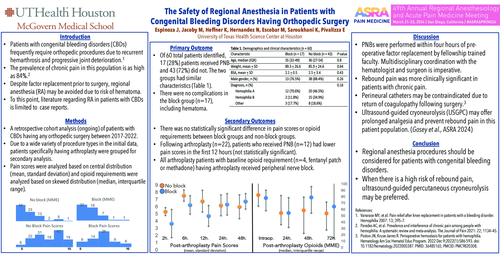
•Of 60 total patients identified, 17 (28%) patients received PNB and 43 (72%) did not. The two groups had similar characteristics (Table 1).
•There were no complications in the block group (n=17), including hematoma.
Hemophilia A
Hemophilia B
Secondary Outcomes
•There was no statistically significant difference in pain scores or opioid requirements between block groups and non-block groups.
•Following arthroplasty (n=22), patients who received PNB (n=12) had lower pain scores in the first 12 hours (not statistically significant).
•All arthroplasty patients with baseline opioid requirement (n=4, fentanyl patch or methadone) having arthroplasty received peripheral nerve block.
Discussion
•PNBs were performed within four hours of pre-operative factor replacement by fellowship trained faculty. Multidisciplinary coordination with the hematologist and surgeon is imperative.
•Rebound pain was more clinically significant in patients with chronic pain.
•Perineural catheters may be contraindicated due to return of coagulopathy following surgery.3
•Ultrasound-guided cryoneurolysis (USGPC) may offer prolonged analgesia and prevent rebound pain in this patient population. (Gosey et al., ASRA 2024)
Conclusion
•Regional anesthesia procedures should be considered for patients with congenital bleeding disorders.
•When there is a high risk of rebound pain, ultrasound-guided percutaneous cryoneurolysis may be preferred.
References:
1.Vanarase MY, et al. Pain relief after knee replacement in patients with a bleeding disorder. Hemophilia 2007: 13; 395–7.
2.Paredes AC, et al. Prevalence and interference of chronic pain among people with hemophilia: A systematic review and meta-analysis. The Journal of Pain 2021: 22; 1134–45.
3.Poston JN, Kruse-Jarres R. Perioperative hemostasis for patients with hemophilia. Hematology Am Soc Hematol Educ Program. 2022 Dec 9;2022(1):586-593. doi: 10.1182/hematology.2022000387. PMID: 36485165; PMCID: PMC9820308.