457 posters, 2 videos, 2 audios, 8 topics, 45 sessions, 401 authors, 265 institutions
ePostersLive by SciGen Technologies S.A. All rights reserved.
49th Annual Regional Anesthesiology and Acute Pain Medicine Meeting
March 21-23, 2024 | The Hilton Bayfront San Diego | San Diego, California

5484
ADOPTION OF A REGIONAL ANESTHESIA QUALITY IMPROVEMENT PROGRAM
Poster Presenter
Authors
Affiliations
Part of Topic
Scientific Abstracts > Regional Anesthesia
Adoption of a regional anesthesia quality improvement program
Fabian Camilo Dorado Velasco, Sabine Nabecker, Pieter de Jager, Christian Hobeika, Josh Gleicher
Introduction Organizational context influences the adoption and sustainability of quality improvement (QI) initiatives. Mount Sinai Hospital (MSH) is a 442-bed tertiary academic hospital affiliated with the University of Toronto. Care provided to patients with complex orthopedic and oncological pathologies is included in the clinical focus of the center. A regional anesthesia (RA) program was established in 2017 for the purpose of expanding the performance of perioperative regional anesthesia and analgesia procedures. This study aims to describe the uptake of the program as a QI project, and to identify and analyze barriers and facilitators to its adoption by staff anesthesiologists.
Materials and Methods This analytical cross-sectional study investigates the adoption of the RA program among anesthesiologists. Using the Consolidated Framework for Implementation Research (CFIR) , a questionnaire was developed to explore barriers and facilitators for the adoption of the RA program. The CFIR, which is a meta-theoretical framework composed of five domains (Intervention characteristics; Inner setting; Outer setting; Individual characteristics; Process) and several constructs, has been used to assess the implementation of different QI interventions. Research Ethic Board approval was obtained. The overall uptake of RA was measured quantitatively by the number of peripheral nerve blocks performed during the study period utilizing procedure codes from the Ontario Health Insurance Plan (OHIP) billing data. Anesthesiologists received an anonymous online survey capturing demographic data and containing 19 questions that represented selected constructs of every CFIR domain. Questions were ranked on a 5-point Likert scale as follows: 1= Strongly disagree; 2= Disagree; 3= Neutral; 4= Agree; 5= Strongly agree. One question allowed participants to self-identify as innovators; early adopters; late adopters; or non-adopters, depending on their perception and skillset at the inception of the RA program. For the statistical analysis, non-adopters were grouped with late-adopters, and the innovator with early-adopters. Results of the survey are described using percentages, median and interquartile rank. The reliability analysis of the questions within each domain was performed using Alpha Cronbach coefficient. Interrater agreement was assessed using the W-Kendal coefficient of concordance. To compare early and late adopters, univariable analysis of data from the CFIR questionnaire was performed with the Wilcoxon rank-sum test. Multivariable ordinal regression analysis was executed to rule out confounding factors from other demographic variables.
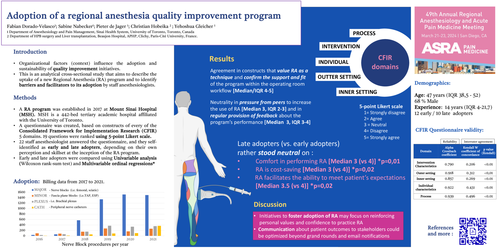
Results/Case Report The cumulative uptake of RA procedures between 2017 and 2021 is depicted in Figure 1. Overall, RA procedures increased from 218 to 2498 within the study period as follows: Peripheral nerve catheters increased 2460% (8 to 369); Major nerve blocks 2628% (57 to 1498); Plexus blocks 577% (62 to 358 blocks); and Minor nerve blocks 314% (84 to 264) (Figure 2). Twenty-five (100 %) anesthesiologists consented to participate, and twenty-two (88%) answered the adoption questionnaire. Median age was 47 years (IQR 38,5 - 52). Sixty-eight % were male. Median years of experience was 14 years (IQR 4-21,7). Eleven (50%) of the participants self-identified as early adopters, eight (36,5%) late adopters, two (9,1%) non-adopters, and one (4,5%) innovator. The reliability of composite questions within domains was high. Interrater agreement between responders was low in the domains Intervention Characteristics, Outer setting, and Inner setting, and moderate in Individual Characteristics and Process domains. (Table 1) Overall group consensus was positive (medians and IQR between 4 and 5) in constructs that value RA as a technique and confirm the support and fit of the RA program within the current workflow. Peer pressure was generally not conceived as a driver to the adoption of RA [3, IQR 2-3], while billing/ and financial aspects were considered an incentive by more than half of the respondents. The median of the provision of feedback to stakeholders about the program’s performance was 3 [IQR 3-4]. In the uni and multivariate analysis, late adopters ranked slightly lower on those constructs in the individual characteristics domain (knowledge/beliefs, self-efficacy, state of change) independently from age, gender, and years of experience. Similarly, late adopters ranked neutral in RA as a costsaving technique (3 [IQR 3, 4] OR 0.09 (CI 0.01-0.68) p = 0.02) and in the ability to meet patient expectations using RA (3.5 [IQR 3, 4] OR 0.05 (CI 0.00-0.48) p = 0.02), whereas early adopters had a positive viewpoint about this statement.
Discussion This study analyzes the influence of context on the adoption of a RA QI project in a tertiary academic setting. The significant uptake of RA practice is evident in the drastic increase in the number of procedures performed throughout the study period. Initiatives that reinforce the personal value given to RA and the confidence to incorporate it in patient care could foster the adoption of RA in anesthesiologist who are newcomers to this technique. Communication about patient outcomes to stakeholders, that include but is not limited to frequent grand rounds and email communications regarding the productivity and success of the RA program, could have been optimized further. Findings from this study may be helpful when auditing and redesigning existing improvement initiatives.
References
1. Kaplan HC, Brady PW, Dritz MC, Hooper DK, Linam WM, Froehle CM, et al. The Influence of Context on Quality Improvement Success in Health Care: A Systematic Review of the Literature. Milbank Q [Internet]. 2010 [cited 2021 Oct 31];88(4):500–59.
2. Constructs – _The Consolidated Framework for Implementation Research [Internet]. [cited 2021 Oct 1]. Available from: https://cfirguide.org/constructs/
3. Kirk MA, Kelley C, Yankey N, Birken SA, Abadie B, Damschroder L. A systematic review of the use of the Consolidated Framework for Implementation Research. Implement Sci [Internet]. 2016 May 17 [cited 2021 Nov 2];11(1):72.
4. Kegler, M. C., Liang, S., Weiner, B. J., Tu, S. P., Friedman, D. B., Glenn, B. A., ... & Fernandez, M. E. (2018). Measuring constructs of the consolidated framework for implementation research in the context of increasing colorectal cancer screening in federally qualified health center. Health services research, 53(6), 4178-4203.
5. Gisev, N., Bell, J. S., & Chen, T. F. (2013). Interrater agreement and interrater reliability: key concepts, approaches, and applications. Research in Social and Administrative Pharmacy, 9(3), 330-338