457 posters, 2 videos, 2 audios, 8 topics, 45 sessions, 401 authors, 265 institutions
ePostersLive by SciGen Technologies S.A. All rights reserved.
49th Annual Regional Anesthesiology and Acute Pain Medicine Meeting
March 21-23, 2024 | The Hilton Bayfront San Diego | San Diego, California

5361
ANALGESIC EFFICACY AND PHARMACOKINETICS OF LIDOCAINE BY ERECTOR SPINAE PLANE VERSUS INTRAVENOUS ROUTE- A RANDOMIZED CLINICAL TRIAL
Poster Presenter
Authors
Affiliations
Part of Topic
Scientific Abstracts > Regional Anesthesia
INTRODUCTION
•The Erector Spinae Plane (ESP) block is a popular regional analgesic technique for providing truncal analgesia
•Primary objective was to evaluate the analgesic efficacy of lidocaine administered through bilateral ESP blocks, in comparison to IV route, following cardiac surgery
•
METHODS
•Prospective randomized clinical trial - open label design.
•Patients were randomized to receive lidocaine 2 mg/kg ideal body weight (IBW) bolus followed by continuous infusion 2 mg/kg/hour IBW, either through continuous bilateral ESP block catheters (ESP group), or intravenous route (IV group) for the first 48 hours postoperatively.
•Lidocaine levels assessed in arterial blood samples at 5, 30, 60, 120 minutes, 6 and 24 hours.
•Pain scores, opioid consumption, and adverse events were assessed.
RESULTS
•61 patients included in final analysis.
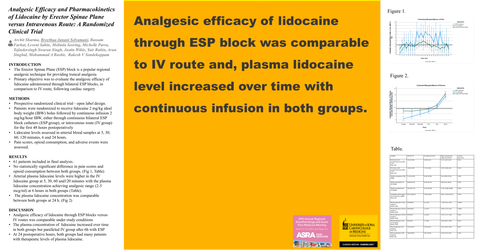
•No statistically significant difference in pain scores and opioid consumption between both groups. (Fig 1, Table)
•Arterial plasma lidocaine levels were higher in the IV lidocaine group at 5, 30, 60 and120 minutes with the plasma lidocaine concentration achieving analgesic range (2-5 mcg/ml) at 6 hours in both groups (Table).
• The plasma lidocaine concentration was comparable between both groups at 24 h. (Fig 2)
DISCUSSION
•Analgesic efficacy of lidocaine through ESP blocks versus IV routes was comparable under study conditions
•The plasma concentration of lidocaine increased over time in both groups but paralleled IV group after 6h with ESP
•At 24 postoperative hours, both groups had many patients with therapeutic levels of plasma lidocaine.