457 posters, 2 videos, 2 audios, 8 topics, 45 sessions, 401 authors, 265 institutions
ePostersLive by SciGen Technologies S.A. All rights reserved.
49th Annual Regional Anesthesiology and Acute Pain Medicine Meeting
March 21-23, 2024 | The Hilton Bayfront San Diego | San Diego, California

5490
LOW/MEDIUM FRAILTY SUBGROUPS MAY BE MORE LIKELY TO BENEFIT FROM REGIONAL OVER GENERAL ANESTHESIA IN SURGICAL HIP FRACTURE PATIENTS
Poster Presenter
Authors
Affiliations
Part of Topic
Scientific Abstracts > Regional Anesthesia
Background
•With millions of patients undergoing hip fracture repair surgery each year, it is critical that anesthesiologists consider factors such as patient frailty, age, and comorbidities when comparing the benefits and risks of anesthetic type.
•The Hospital Frailty Risk Score (HFRS) is a validated score used across various specialties to categorize geriatric patients as low, intermediate, or high risk of frailty.
•There is a dearth of literature on the perioperative outcomes experienced by hip fracture surgery patients of different frailty levels who received general (GA) or neuraxial anesthesia (NA).
•While clinical trial data has shown no differences in outcomes between GA or NA in surgical hip fracture patients, there may be subgroups (e.g. those based on frailty) that could potentially benefit from either approach.
•We aimed to assess whether certain frailty subgroups are more likely to benefit from NA over GA using a large national claims dataset.
Methods
•This study was approved by the Institutional Review Board at the Hospital for Special Surgery (IRB#2012-050). The requirement for written informed consent was waived given the de-identified nature of the data.
•This retrospective cohort study included data from 268,185 surgical hip fracture patients between 2016 and 2021, as recorded in the Premier Healthcare (Premier Inc, Charlotte, North Carolina) all-payer claims dataset.
•Patients were grouped based on age(quantiles, ≤71, 72-86, ≥87 years) and HFRS frailty groups (low/medium combined and high).
•Outcomes of interest: mortality, delirium, cardiac complications, respiratory complications, acute renal failure, intensive care unit (ICU) admission, high opioid use (>75th percentile), and prolonged length of stay (>75th percentile).
•Multivariable mixed-effects models measured the association between anesthesia type and outcomes separately in each of the 6 patient subgroups based on age and frailty.
•We report odds ratios (OR) and 95% confidence intervals.
Results
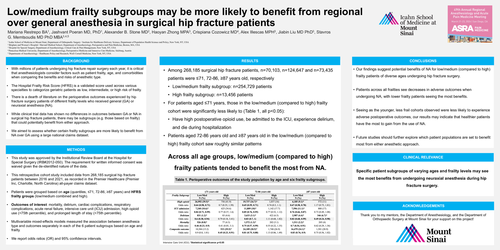
•Among 268,185 surgical hip fracture patients, n=70,103, n=124,647 and n=73,435 patients were ≤71, 72-86, ≥87 years old, respectively
•Low/medium frailty subgroup: n=254,729 patients
•High frailty subgroup: n=13,456 patients
•For patients aged ≤71 years, those in the low/medium (compared to high) frailty cohort were significantly less likely to (Table 1, all p<0.05):
•Have high postoperative opioid use, be admitted to the ICU, experience delirium, and die during hospitalization
•Patients aged 72-86 years old and ≥87 years old in the low/medium (compared to high) frailty cohort saw roughly similar patterns
•Across all age groups, low/medium (compared to high) frailty patients tended to benefit the most from NA.
Conclusions
•Our findings suggest potential benefits of NA for low/medium (compared to high) frailty patients of diverse ages undergoing hip fracture surgery.
•Patients across all frailties see decreases in adverse outcomes when undergoing NA, with lower frailty patients seeing the most benefits.
•Seeing as the younger, less frail cohorts observed were less likely to experience adverse postoperative outcomes, our results may indicate that healthier patients have the most to gain from the use of NA.
•Future studies should further explore which patient populations are set to benefit most from either anesthetic approach.
Clinical Relevance
Specific patient subgroups of varying ages and frailty levels may see the most benefits from undergoing neuraxial anesthesia during hip fracture surgery.