Loading...

457 posters, 2 videos, 2 audios, 8 topics, 45 sessions, 401 authors, 265 institutions

ePostersLive by SciGen Technologies S.A. All rights reserved.

49th Annual Regional Anesthesiology and Acute Pain Medicine Meeting

March 21-23, 2024 | The Hilton Bayfront San Diego | San Diego, California

49th Annual Regional Anesthesiology and Acute Pain Medicine Meeting banner

5444

THE EFFECT OF DEXAMETHASONE ON REBOUND PAIN AFTER REGIONAL ANESTHESIA FOR AMBULATORY SURGERY: A RETROSPECTIVE COHORT STUDY
Part of Topic

Scientific Abstracts > Regional Anesthesia

BACKGROUND: Rebound pain after peripheral nerve block (PNB) is defined as a severe, rapid increase in pain after the PNB has worn off. Previous studies have identified dexamethasone administration as one of the modifiable factors to reduce the risk of rebound pain

Objective: to determine the optimal dose and timing of dexamethasone associated with a reduced incidence and severity of rebound pain in ambulatory surgery patients.

METHODS

1.REB approval obtained for retrospective cohort study of adult patients who received single shot PNB for ambulatory surgery at QEII Health Sciences Centre between March 2017 – December 2022
2.Data collected from block room follow-up phone call questionnaire and electronic health records
3.Exclusions: overnight hospital admission, highly opioid-tolerant patients, and patients who received a continuous peripheral nerve catheter.
4.Primary outcome was incidence of rebound pain
5.Secondary outcome was the rebound pain score (RPS) to measure severity of rebound pain
6.Statistics performed in SPSS: univariate and multivariable regression, logistic regression for binary outcome incidence of rebound pain, linear regression for outcome of rebound pain score.

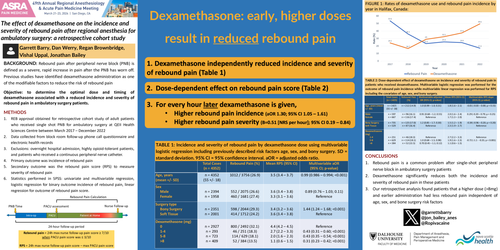
Dexamethasone: early, higher doses result in reduced rebound pain

1. Dexamethasone independently reduced incidence and severity of rebound pain (Table 1)

2. Dose-dependent effect on rebound pain score (Table 2)

3. For every hour laterdexamethasone is given,
•Higher rebound pain incidence (aOR 1.30; 95% CI 1.05 – 1.61)
•Higher rebound pain severity (B=0.51 [NRS per hour]; 95% CI 0.19 – 0.84)

CONCLUSIONS

1.Rebound pain is a common problem after single-shot peripheral nerve block in ambulatory surgery patients
2.Dexamethasone significantly reduces both the incidence and severity of rebound pain in these patients
3.Our retrospective analysis found patients that a higher dose (>8mg) and earlier administration had less rebound pain independent of age, sex, and bone surgery risk factors
49th Annual Regional Anesthesiology and Acute Pain Medicine Meeting » banner
Copyright © 2015-2026, ePostersLive® SciGen is a registered trademark of SciGen Technologies S.A. Patent pending.

This website and third-party tools we use rely on cookies for the best user experience. By selecting "I agree", you agree to cookie usage as described in our Privacy Policy.