457 posters, 2 videos, 2 audios, 8 topics, 45 sessions, 401 authors, 265 institutions
ePostersLive by SciGen Technologies S.A. All rights reserved.
49th Annual Regional Anesthesiology and Acute Pain Medicine Meeting
March 21-23, 2024 | The Hilton Bayfront San Diego | San Diego, California

5441
EVALUATING THE EFFECT OF BMI ON ELECTIVE PERIPHERAL NERVE BLOCK UTILIZATION WITHIN PATIENTS UNDERGOING INTRA-ABDOMINAL SURGERIES
Poster Presenter
Authors
Affiliations
Part of Topic
Scientific Abstracts > Regional Anesthesia
Evaluating the Effect of BMI on Elective Peripheral Nerve Block Utilization In Patients Undergoing Intra-Abdominal Surgeries
Introduction
Within the United States the prevalence of overweight (BMI >25) and obese adults (BMI > 30) continues to increase, and recent reports suggest that approximately 73% of adults are overweight and 43%, obese, , based on body mass index (BMI) measurements(1). Patients with higher BMIs, pose technical challenges when providing regional anesthetic (RA) care, such as increased difficulty with positioning and identifying anatomic landmarks. While ultrasound guidance has become the gold-standard technique for the performance of RA, excess adipose tissue attenuates ultrasound beams, leading to poorer image quality and increased artifact(2). A multitude of studies across different specialties have reported how patient factors such as race/ethnicity, primary language, and insurance type may be associated with disparities in RA utilization(3,4). However, research into how patient BMI may affect RA usage is sparse, and specifically, there are no studies that evaluate the impact of BMI on the use of RA for patients undergoing intra-abdominal procedures. The objective of this study was to evaluate the impact that BMI has on elective adjunctive RA utilization. We hypothesized that patients with higher BMIs would receive peripheral nerve blocks (PNBs) less frequently when compared to patients with lower BMIs, even when corrected for demographic and health factors.
Materials and Methods
This IRB-approved retrospective study included patients 18 years or older who underwent intra-abdominal surgery within a single health system between January 2018 and April 2023. Demographic and medical data was queried and extracted via the EPIC EHR system. Identification of patient population was done via CPT codes related to intra-abdominal gallbladder, appendix, gastric, colon, small bowel, hernia, prostrate, uterine, ovarian, and rectal procedures. Demographic information collected included age, sex, and primary language. Medical data extracted include BMI, ASA score, procedure type, use of PNBs, emergency/elective status, and ICD10 codes associated with the hospital encounter. Statistical analysis was performed in R version 4.3.2. Univariate logistic regression was conducted to evaluate the association of BMI and PNB utilization. In addition, a multivariate logistic regression accounting for each patient’s demographic and medical data was conducted to evaluate the association of BMI and PNB utilization. P-values were reported for all statistical tests, and P<0.05 was considered statistically significant.
Results
Study Population
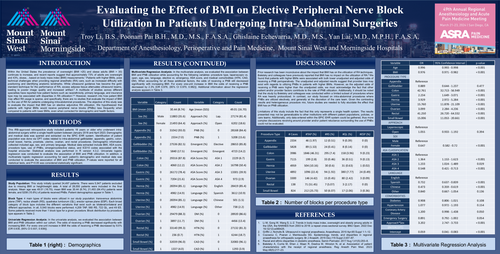
This study initially queried 34,497 patients. There were 5,947 patients excluded due to missing BMI or height/weight data. A total of 28,550 patients were included in the final analysis. Mean age was 49.01 (16.70), mean BMI was 30.44 (8.74), 21,493 (64.4%) patients were female, and 5208 (15.6%) of patients received PNBs. Patient demographics appear in Table 1.
Block Type
4 main types of blocks were utilized in our study population: transversus abdominis plane (TAP), rectus sheath (RS), quadratus lumborum (QL), erector spinae plane (ESP). Each broad category of block type includes the different variations that exist such as bilateral/unilateral and different approaches. In all, 5,540 blocks were performed: 4,209 TAP, 560 RS, 722 QL, and 49 ES. Some patients received more than 1 block type for a given procedure. Block distribution by procedure type appears in Table 2.
Univariate Regression Analysis
In the univariate analysis, we evaluated the association between BMI and PNB utilization within our cohort. The odds of receiving a PNB decreased significantly with increasing BMI. For every one-unit increase in BMI the odds of receiving a PNB decreased by 6.5% [OR 0.935, (95% CI 0.931, 0.939)].
Multivariate Regression Analysis
In the multivariate analysis, we evaluated the association between BMI and PNB utilization while accounting for the following variables: procedure type, laparoscopic vs. open, age, sex, language, elective vs. emergency, ASA score, and medical comorbidities (HTN, CAD, DM). When accounting for all these additional factors, the odds of receiving a PNB still decreased significantly with increasing BMI. For every one-unit increase in BMI the odds of receiving a PNB decreased by 2.3% [OR 0.976, (95% CI 0.970, 0.982)]. Additional information about the regression analysis appears in Table 3.
Discussion
Prior research has been inconclusive about the impact that BMI has on the utilization of RA techniques. Beletsky and colleagues have previously reported that BMI has no impact on the utilization of RA(5). We found that patients with higher BMIs were associated with both lower unadjusted and adjusted odds of receiving a PNB perioperatively. The unadjusted and adjusted results suggest that provider bias may exist with regards to utilizing PNBs in patients with higher BMIs. However, as the adjusted odds of receiving a PNB were higher than the unadjusted odds, we must acknowledge the fact that other patient and/or provider factors contribute to the rate of PNB utilization. Additionally, it should be noted that the study by Beletsky and colleagues was conducted within a limited subset of procedures where RA was heavily protocolized. In contrast, our study focused on intra-abdominal procedures where PNBs are utilized electively, and generally at the discretion of the care team. Given the contrasting results and heterogeneous procedure mix, future studies are needed to fully elucidate the effect that BMI has on PNB utilization.
Limitations of this study include the fact that this only represents a single health system. The results presented may not be generalizable to other institutions with different patient populations, policies, or care teams. Additionally, only data entered within the EPIC EHR system could be gathered, thus more complex discussions revolving around provider and/or patient reluctance surrounding the use of PNBs could not be evaluated.