457 posters, 2 videos, 2 audios, 8 topics, 45 sessions, 401 authors, 265 institutions
ePostersLive by SciGen Technologies S.A. All rights reserved.
49th Annual Regional Anesthesiology and Acute Pain Medicine Meeting
March 21-23, 2024 | The Hilton Bayfront San Diego | San Diego, California

5400
PERIPHERAL NERVE BLOCKS IN PRE-EXISTING BRACHIAL PLEXUS INJURIES
Poster Presenter
Authors
Affiliations
Part of Topic
Scientific Abstracts > Regional Anesthesia
Peripheral Nerve Blocks in a Patient with Pre-existing Brachial Plexus Injuries
Dominique Chang MD, Nick Winokur BA, Naum Shaparin MD, Preeti Anand MD
INTRODUCTION
Peripheral nerve blocks (PNBs) are an established approach to pain management. Compared to systemic analgesia or general anesthesia (GA) alone, patients who receive PNBs exhibit lower postoperative opioid consumption and pain scores. Optimal pain management is especially relevant in patients with pre-existing traumatic brachial plexus injury due to the numerous surgeries often required to restore motor and sensory function, as well as the high incidence of neuropathic pain, seen in up to 95% of cases and nociceptive pain from secondary ligament and joint injuries.
CASE REPORT
A 24-year-old, ASA I, left-handed male sustained a grade IIIC open left clavicular fracture during an MVA which resulted in subclavian artery injury, requiring a PTFE graft from the axillary to the carotid arteries. Possible medial and lateral cord injuries as well as ulnar and median nerve lacerations were also discovered. Post initial reconstructive surgery, sensory and motor deficits were noted in these distributions. A second reconstructive attempt resulted in partial sensory, motor, and functional improvement of his left upper extremity (LUE).
Two subsequent surgeries to achieve further improvement in LUE function were performed using PNBs. Interscalene and intercostobrachial blocks were performed together with GA in the first instance, while supraclavicular and intercostobrachial blocks were the primary anesthetic with sedation on the following occasion.
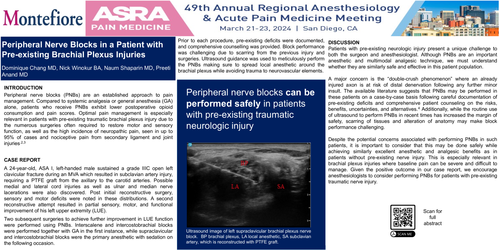
Prior to each procedure, pre-existing deficits were documented, and comprehensive counselling was provided. Block performance was challenging due to scarring from the previous injury and surgeries. Ultrasound guidance was used to meticulously perform the PNBs making sure to spread local anesthetic around the brachial plexus while avoiding trauma to neurovascular elements.
DISCUSSION
Patients with pre-existing neurologic injury present a unique challenge to both the surgeon and anesthesiologist. Although PNBs are an important anesthetic and multimodal analgesic technique, we must understand whether they are similarly safe and effective in this patient population.
A major concern is the “double-crush phenomenon” where an already injured axon is at risk of distal denervation following any further minor insult. The available literature suggests that PNBs may be performed in these patients on a case-by-case basis following careful documentation of pre-existing deficits and comprehensive patient counseling on the risks, benefits, uncertainties, and alternatives.4 Additionally, while the routine use of ultrasound to perform PNBs in recent times has increased the margin of safety, scarring of tissues and alteration of anatomy may make block performance challenging.
Despite the potential concerns associated with performing PNBs in such patients, it is important to consider that this may be done safely while achieving similarly excellent anesthetic and analgesic benefits as in patients without pre-existing nerve injury. This is especially relevant in brachial plexus injuries where baseline pain can be severe and difficult to manage. Given the positive outcome in our case report, we encourage anesthesiologists to consider performing PNBs for patients with pre-existing traumatic nerve injury.