457 posters, 2 videos, 2 audios, 8 topics, 45 sessions, 401 authors, 265 institutions
ePostersLive by SciGen Technologies S.A. All rights reserved.
49th Annual Regional Anesthesiology and Acute Pain Medicine Meeting
March 21-23, 2024 | The Hilton Bayfront San Diego | San Diego, California

5299
RELATIVE PERIOPERATIVE ANALGESIC EFFICACY OF SERRATUS ANTERIOR PLANE BLOCK VS PARAVERTEBRAL BLOCK IN BREAST AND THORACIC SURGERY-
Poster Presenter
Authors
Affiliations
Part of Topic
Scientific Abstracts > Regional Anesthesia
To accumulate evidence from published randomized controlled trials (RCTs) on the relative analgesic efficacy of SAP and TPVblock for breast and thoracic surgery
Search strategy
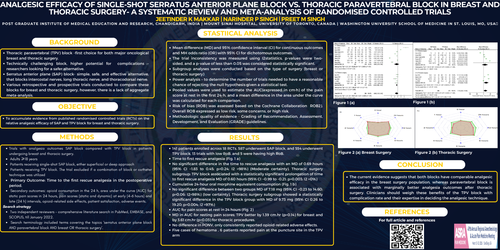
141 patients enrolled across 18 RCTs. 587 underwent SAP block, and 554 underwent TPV block. 13 trials with low RoB, and 5 were having high RoB.
Time to first rescue analgesia (Fig. 1 a)
No significant difference in the time to rescue analgesia with an MD of 0.69 hours (95% CI −1.83 to 0.45; p=0.24; I2 =98%) (Moderate certainty). Thoracic surgery subgroup: TPV block associated with a statistically significant prolongation of time to first rescue analgesia MD of 0.60 hours (95% CI −0.99 to -0.21; p=0.003; I2 =0%)
Cumulative 24-hour oral morphine equivalent consumption (Fig. 1 b)
No significant difference between the two groups MD of 7.18 mg (95% CI −0.23 to 14.60; p=0.06; I2=98%) (low certainty). Thoracic surgery subgroup showed a statistically significant difference in the TPV block group with MD of 9.73 mg (95% CI 0.26 to 19.20; p=0.004; I2 =97%)
AUC for pain scores at rest in 24 hours (Fig. 2)
MD in AUC for resting pain scores showed that TPV was better by 1.39 cm.hr (p=0.14) for breast and by 3.61 cm.hr (p=0.03) for thoracic procedures.
No difference in PONV, only consistently reported opioid-related adverse effects.
Five cases of hematoma and 6 patients reported pain at the puncture site in the TPV arm, and no block-related complications were encountered in the SAP group.
Conclusion
The current evidence suggests that both blocks have comparable analgesic efficacy in the breast surgery population, whereas paravertebral block is associated with marginally better analgesia outcomes after thoracic surgery. Clinicians should weigh these benefits of the TPV block with complication rate and their expertise in deciding the analgesic technique.