457 posters, 2 videos, 2 audios, 8 topics, 45 sessions, 401 authors, 265 institutions
ePostersLive by SciGen Technologies S.A. All rights reserved.
49th Annual Regional Anesthesiology and Acute Pain Medicine Meeting
March 21-23, 2024 | The Hilton Bayfront San Diego | San Diego, California

5407
MORBIDITY AND MORTALITY FOLLOWING TOTAL HIP AND KNEE ARTHROPLASTY WITH SPINAL VS. GENERAL ANESTHESIA: A RETROSPECTIVE ANALYSIS
Poster Presenter
Authors
Affiliations
Part of Topic
Scientific Abstracts > Regional Anesthesia
Despite longstanding debate surrounding anesthesia in total joint arthroplasty, the topic remains controversial, and an optimal anesthetic mode has yet to be clearly identified. Historically, general anesthesia (GA) was recommended for total hip and knee arthroplasty (THA, TKA); however, in more recent years, spinal anesthesia (SA) has become more popular, especially in elderly patients with comorbidities [3]. Although multiple investigators have explored this topic, their conclusions are conflicting. Some studies have reported increased incidence of hypotension, motor blockade, urinary retention, and pruritis with SA [1,5,7,10]. On the other hand, some authors have reported increased blood loss, length of hospital stay, nausea, infection, and thromboembolic events with GA [4,8,9].
In comparison, hip fracture literature does not demonstrate superiority of SA or GA with multiple authors concluding that both methods are viable and comparable in morbidity and mortality [2,6,11]. This difference in reporting is interesting considering the similarities between THA and hip fracture repair. Therefore, despite previous studies examining anesthesia techniques in total joint arthroplasty, there is more room to explore this topic.
The purpose of this study is to further investigate the relationship between total joint arthroplasty outcomes and anesthesia type in order to determine if there is a significant difference in morbidity and mortality between patients undergoing spinal anesthesia compared with those undergoing general anesthesia during primary total hip and knee arthroplasty.
Patients undergoing primary total hip or knee arthroplasty from February 2007 to February 2021 were retrospectively reviewed. From this population, two cohorts were created: GA (n = 2154) and SA (n = 3152). Readmission within 90 days, mortality within one year, and thromboembolic events in the postoperative 30 days were compared using logistic regression analysis. The multivariate model controlled for age and Charlson Comorbidity Index (CCI).
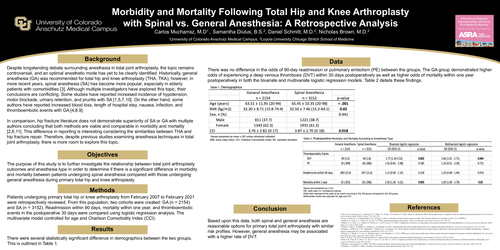
There were several statistically significant difference in demographics between the two groups. This is outlined in Table 1.
There was no difference in the odds of 90-day readmission or pulmonary embolism (PE) between the groups. The GA group demonstrated higher odds of experiencing a deep venous thrombosis (DVT) within 30 days postoperatively as well as higher odds of mortality within one year postoperatively in both the bivariate and multivariate logistic regression models. Table 2 details these findings.
Based upon this data, both spinal and general anesthesia are reasonable options for primary total joint arthroplasty with similar risk profiles. However, general anesthesia may be associated with a higher rate of DVT.