457 posters, 2 videos, 2 audios, 8 topics, 45 sessions, 401 authors, 265 institutions
ePostersLive by SciGen Technologies S.A. All rights reserved.
49th Annual Regional Anesthesiology and Acute Pain Medicine Meeting
March 21-23, 2024 | The Hilton Bayfront San Diego | San Diego, California

5278
EVALUATING ADJUVENT THERAPIES TO INTERSCALENE BLOCKS FOR UPPER EXTREMITY SURGERY: AN INTERM ANALYSIS
Poster Presenter
Authors
Affiliations
Part of Topic
Scientific Abstracts > Regional Anesthesia
Introduction:
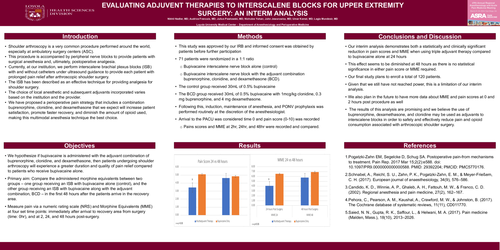
Shoulder arthroscopy is a very common procedure performed around the world, especially at ambulatory surgery centers (ASC). This procedure is accompanied by peripheral nerve blocks to provide patients with surgical anesthesia and, ultimately, postoperative analgesia. Currently, at our institution, we perform interscalene brachial plexus blocks (ISB) with and without catheters under ultrasound guidance to provide each patient with prolonged pain relief after arthroscopic shoulder surgery. The ISB has been described as an effective technique for providing analgesia for shoulder surgery. The choice of local anesthetic and subsequent adjuvants incorporated varies based on the institution and the provider. We have proposed a perioperative pain strategy that includes a combination buprenorphine, clonidine, and dexamethasone that we expect will increase patient satisfaction, promote faster recovery, and diminish the amount of opioid used, making this multimodal anesthesia technique the best choice.
Materials and Methods:
This study was approved by our IRB andinformed consentwas obtained by patients before further participation. 71 patients were randomized in a 1:1 ratio to receive either a bupivacaine interscalene nerve block alone (control) or with the adjuvant combination buprenorphine, clonidine, and dexamethasone (BCD). The control groupreceived 30mL of 0.5% bupivacaine, and the BCD groupreceived 30mL of 0.5% bupivacaine with 100 mcg clonidine, 0.3 mg buprenorphine, and 4 mg dexamethasone. Following this, induction, maintenance of anesthesia, and PONV prophylaxis wasperformed routinely at the discretionof the anesthesiologist. After extubation and arrival to the PACU was considered time 0 and at this time, pain score (0-10) was recorded and then recorded again at hours 2, 24, and 48 along with morphine equivalents taken for pain control during that time.
Results:
Our preliminary study cohort consisted of 71 total patients, (35 in the controlgroup and 36 in the BCD group). Average pain score at 24 hours for the control group for 5.08 and BCD group was 3.44 (p <0.05). At 48 hoursaverage pain score for the control group was 4.83 and the BCD group was 4.83. Average morphine equivalents needed for at 24 hours forcontrol group was 6.50 MME and BCD group was 4.06 MME (p<0.05). Average morphine equivalents needed after 48 hours for the control group was 6.88 and for the BCD group was 5.76.
Discussion:
Our interim analysisdemonstrates both a statistically and clinically significant reduction in pain scores and MME when using triple adjuvant therapy compared to bupivacaine alone at 24 hours, this effect seems to bediminished at 48 hours as there is no statistical significance in either pain score or MME required.Our study plans to enroll a total of 120 patients. Given that we still have not reached power, this is a limitation of our interim analysis. We also plan in the future to have more data about MME and pain scores at 0 and 2 hours post procedure. The results of this analysis are promisingand we believe the use of buprenorphine, dexamethasone, and clonidine may be used as adjuvants to interscalene blocks in order to safely and effectively reduce pain and opioid consumption associated with arthroscopic shoulder surgery.