457 posters, 2 videos, 2 audios, 8 topics, 45 sessions, 401 authors, 265 institutions
ePostersLive by SciGen Technologies S.A. All rights reserved.
49th Annual Regional Anesthesiology and Acute Pain Medicine Meeting
March 21-23, 2024 | The Hilton Bayfront San Diego | San Diego, California

5235
PREDICTING SAFE RE-DOSING OF BUPIVACAINE AND ROPIVACAINE IN TRUNCAL CATHETERS
Poster Presenter
Authors
Affiliations
Part of Topic
Scientific Abstracts > Regional Anesthesia
Title: Predicting safe re-dosing of bupivacaine and ropivacaine in truncal catheters
Authors: 1,2Brittani Bungart MD PhD, 1,2Lana Joudeh MD, 3Eric S. Schwenk MD, 4Michael Fettiplace MD PhD
Affiliations: 1Department of Anesthesia, Critical Care and Pain Medicine, Massachusetts General Hospital, Boston, MA, USA; 2Department of Anaesthesia, Harvard Medical School, Boston, MA, USA; 3Department of Anesthesiology and Perioperative Medicine, Sidney Kimmel Medical College at Thomas Jefferson University, Philadelphia, PA, USA; 4Department of Anesthesiology, University of Illinois Health, Chicago, IL, USA
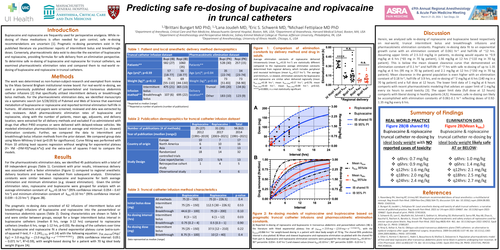
Introduction: Bupivacaine and ropivacaine are frequently used for perioperative analgesia. While re-dosing of these medications is often needed for pain control, safe re-dosing recommendations are uncertain [1]. Pragmatic re-dosing parameters exist in the published literature via practitioner reports of intermittent bolus and breakthrough doses. Conversely, pharmacokinetic data exist to describe the excretion of bupivacaine and ropivacaine, providing formulas for safe delivery from an elimination perspective. To determine safe re-dosing of bupivacaine and ropivacaine for truncal catheters, we examined pharmacokinetic elimination rates and compared them to real-world re-dosing of bupivacaine and ropivacaine in truncal catheters.
Methods: The work was determined as non-human-subject-research and exempted from review by the Mass General Brigham institutional review board. For real-world re-dosing, we used a previously published dataset of paravertebral and transversus abdominis catheter infusions [2] that specifically utilized intermittent delivery or breakthrough bolus methods. For the pharmacokinetic elimination data, we identified manuscripts via a systematic search (on 5/28/2023) of Pubmed and Web of Science that examined metabolism of bupivacaine or ropivacaine and reported terminal elimination half-life in humans. All abstracts and papers were screened, reviewed and data was extracted by two reviewers. Adult pharmacokinetic elimination rates of bupivacaine and ropivacaine, along with the number of patients, mean age, adjuvants, and delivery location, were extracted for all delivery methods and excluded if co-administered with drugs that affect P450 enzymes or were delivered with delayed-release vehicles. We modeled elimination pharmacokinetics based on average and minimum (i.e. slowest) elimination constants. Further, we compared the data to intermittent and breakthrough bolus infusion methods from the prior dataset. We compared group data using Mann-Whitney U-test (p<0.05 for significance). Curve fitting was performed with Prism 10 utilizing least squares regression without weighing for exponential plateau (Y= YM –{YM-Y0}*exp{-k*x}) and the extra-sum of squares F-test to compare the models.
Results: For the pharmacokinetic elimination data, we identified 45 publications with a total of 69 independent groups (Table 1). Consistent with prior results, intravenous delivery was associated with a faster elimination (Figure 1) compared to regional anesthetic delivery locations and were thus excluded from subsequent analysis. Elimination constants were similar between ropivacaine and bupivacaine for both average elimination and minimum elimination (e.g. slowest elimination). Given the similar elimination rates, ropivacaine and bupivacaine were grouped for analysis with an average elimination constant of kAve=0.18 hrs-1 (95% confidence interval: 0.054 – 0.47 hrs-1) and minimum elimination constant of kMin=0.10 hrs-1 (95% confidence interval: 0.039 – 0.23 hrs-1) (Figure 2B).
The pragmatic re-dosing data consisted of 62 infusions of intermittent bolus and breakthrough infusions of bupivacaine and ropivacaine into the paravertebral or transversus abdominis spaces (Table 2). Dosing characteristics are shown in Table 3 and were similar between groups, except for a longer intermittent bolus interval in bupivacaine catheters (median 8 hrs, range 3-12 hrs) compared to ropivacaine catheters (median 6 hrs, range 1-12 hrs, p=0.03). Re-dosing of the catheters over time with bupivacaine and ropivacaine fit a shared exponential plateau curve (extra-sum-of-squared F-test, F = 2.241(1,72), p=0.14) with the following equation: yIB_shared (mg/kg)=3.0 mg/kg-(3.0 mg/kg*e-1∗time∗0.061) (95% confidence interval: 0.051 – 0.071 hr-1, R2=0.59), with weight-based dosing for a patient with 70 kg ideal body weight (Figure 2A).
Discussion: Herein, we analyzed safe re-dosing of ropivacaine and bupivacaine based respectively on real-world, truncal intermittent bolus and breakthrough infusions and pharmacokinetic elimination constants. Pragmatic re-dosing data fit to an exponential growth curve with an elimination constant of 0.061 hr-1 and half-life of ~12 hrs. Assuming upper limits of 2.5-3.0 mg/kg in patients, re-dosing would equate to ~0.9 mg/kg at 6 hrs(~65 mg in 70 kg patient), 1.56 mg/kg at 12 hrs (~110 mg in 70 kg patient). This is below the mean slowest clearance curve that demonstrated an elimination constant of 0.1 hr-1 and half-life of ~7 hrs with safe re-dosing of up to 1.35 mg/kg at 6 hrs (95 mg in 70 kg patient) and 2.1 mg/kg at 12 hrs (~150 mg in 70 kg patient). Mean clearance in the general population is even higher with an elimination constant of 0.18 hr-1, half-life of 3.9 hrs, and re-dosing of ~2 mg/kg at 6 hrs(140 mg in a 70 kg patient) and a full dose at 12 hours. The lower limit data of 1 mg/kg at 6 hours comports with recent pharmacokinetic modeling that advises an upper limit of 1 mg/kg every six hours to avoid toxicity [3]. The upper limit data (full dose at 12 hours) comports with liberal dosing in healthy patients [4,5]. However, safe re-dosing can likely be accomplished with elimination constants of 0.061-0.1 hr-1 reflecting doses of 0.92-1.35 mg/kg every 6 hrs.
Summary of Findings:
REAL WORLD PRACTICE (Figure 2B[IB shared fit])
Bupivacaine & ropivacaine truncal catheter re-dosing by ideal body weight with NO reported cases of toxicity:
ELIMINATION DATA (Figure 2B[Mean kMin])
Bupivacaine & ropivacaine truncal catheter re-dosing by ideal body weight likely safe AT or BELOW:
1. Rosenberg PH, Veering BT, Urmey WF. Maximum recommended doses of local anesthetics: a multifactorial concept. Reg Anesth Pain Med. 2004 Nov-Dec;29(6):564-75; discussion 524. doi: 10.1016/j.rapm.2004.08.003. PMID: 15635516.
2. Bungart B, Joudeh L, Fettiplace M. Local anesthetic dosing and toxicity of adult truncal catheters: a narrative review of published practice. Reg Anesth Pain Med. 2023 Jul 14:rapm-2023-104667. doi: 10.1136/rapm-2023-104667. Epub ahead of print. PMID: 37451826.
3. Schwenk ES, Lam E, Abulfathi AA, Schmidt S, Gebhart A, Witzeling SD, Mohamod D, Sarna RR, Roy AB, Zhao JL, Kaushal G, Rochani A, Baratta JL, Viscusi ER. Population pharmacokinetic and safety analysis of ropivacaine used for erector spinae plane blocks. Reg Anesth Pain Med. 2023 Sep;48(9):454- 461. doi: 10.1136/rapm-2022-104252. Epub 2023 Apr 21. PMID: 37085287.
4. Niraj G, Kelkar A, Fox AJ. Oblique sub-costal transversus abdominis plane (TAP) catheters: an alternative to epidural analgesia after upper abdominal surgery. Anaesthesia. 2009 Oct;64(10):1137-40. doi: 10.1111/j.1365-2044.2009.06006.x. PMID: 19735408.
5. Ollier E, Heritier F, Bonnet C, Hodin S, Beauchesne B, Molliex S, Delavenne X. Population pharmacokinetic model of free and total ropivacaine after transversus abdominis plane nerve block in patients undergoing liver resection. Br J Clin Pharmacol. 2015 Jul;80(1):67-74. doi: 10.1111/bcp.12582. Epub 2015 May 28. PMID: 25557141; PMCID: PMC4500326.