457 posters, 2 videos, 2 audios, 8 topics, 45 sessions, 401 authors, 265 institutions
ePostersLive by SciGen Technologies S.A. All rights reserved.
49th Annual Regional Anesthesiology and Acute Pain Medicine Meeting
March 21-23, 2024 | The Hilton Bayfront San Diego | San Diego, California

5434
CONTINUOUS PERINEURAL CATHETER, LIPOSOMAL BUPIVACAINE, AND DEXAMETHASONE FOR INTERSCALENE BLOCK IN TOTAL SHOULDER ARTHROPLASTY
Poster Presenter
Authors
Affiliations
Part of Topic
Scientific Abstracts > Regional Anesthesia
Introduction
Interscalene catheters (ISC) are considered the gold standard for perioperative pain control after total shoulder arthroplasty (TSA) for up to 72 hours.1,2,3 Liposomal bupivacaine (LB) for interscalene blocks (ISB), has been presented as an option for extended analgesia, offering a similar analgesic profile to ISC.1,4,5 In addition, other adjuvants such as dexamethasone have been utilized to prolong the duration of analgesia.5 We aimed to compare the analgesic efficacy of LB to a single shot ISB (SISB) bupivacaine with dexamethasone and an ISC with plain bupivacaine. We hypothesized that a single injection of LB or dexamethasone as an adjunct for an ISB will provide non-inferior duration and quality of analgesia compared to ISC. We also compared functional recovery, cost-effectiveness, as well as adverse effects. A prospective triple blinded randomized control trial (RCT) was conducted to assess the analgesic efficacy among the three groups.
Materials and Methods
All patients were scheduled to undergo elective unilateral, primary TSA (reverse or anatomic), between the age of 18-80 years, were assessed for eligibility and recruited between 2018-2022 at a single academic center. This study was registered on clinical trials.gov.in NCT03969875. All patients provided written consent to participate, and all patient protected health information has been de-identified. This study was completed in accordance with the Consolidated Standards of Reporting Trials (CONSORT) guidelines and received IRB approval at Mount Sinai Health System (New York, NY). Exclusion criteria included patients who were unable to consent, or did not speak English, revision cases, presence of coagulopathy, severe lung disease (use of home oxygen, preoperative baseline oxygen saturation <94% on room air, forced expiratory volume in 1 second <60% of predicted value), contralateral diaphragmatic palsy/ phrenic nerve palsy, insulin-dependent diabetes, hepatic failure (acute hepatic failure or cirrhosis), kidney failure (Creatinine>2.0/ estimated glomerular filtration rate <50 ml/min), pregnancy, chronic opioid use (>3 months), body mass index(BMI) >40, allergy to study medications.
Potential study patients were identified from the operating room schedule. A research assistant reviewed the informed consent with the patients in the preoperative evaluation clinic or over the phone prior to surgery. On the day of surgery, patients were randomized using computer-generated tables and sealed, opaque envelopes. All eligible study patients with an American Society of Anesthesiologists physical classification of 1 to 3 scheduled for elective primary TSA were randomized.
Group A: SISB with 0.5% bupivacaine 15 ml with rescue catheter left in situ attached to a PCA pump with bupivacaine infusion at 6cc/hour postoperatively in the recovery room- the control group.
Group B: SISB with 0.5% bupivacaine 14 ml with l of 4mg dexamethasone (1 mL), total 15 ml bolus with a catheter left in situ to be attached to a PCA pump with normal saline at 6cc/hour postoperatively in the recovery room.
Group C: SISB with 10 ml of liposomal bupivacaine (133 mg) with 0.5% bupivacaine 5 ml, a total 15ml with a catheter left in situ to be attached to a PCA pump with normal saline at 6cc/hour postoperatively in the recovery room.
The primary outcome was the worst NRS (numeric rating scale) measured on arrival to PACU, 6 hours, 12 hours, 24 hours, and 36 hours postoperatively. Secondary outcomes recorded were time to first analgesic request, intraoperative opioid consumption, total inpatient opioid consumption, arm weakness (0 to 24 hours, 24 to 48 hours), arm numbness (0 to 24 hours, 24 to 48 hours), time of analgesia duration (defined as the onset of sensory discomfort that required medication), time of motor recovery (defined as the recovery of full motor function of both wrist and elbow on the nerve block side), sensory testing using pinprick on POD1, Q36, Q48, hand strength assessment using dynamometer POD1, Q36, Q48, PACU and hospital length of stay. Other outcomes recorded were any associated complications such as nausea, vomiting, dizziness, Horner's syndrome, hoarseness, dyspnea, sleep quality, and patient satisfaction scores. PROMIS functionality assessment questionnaire was also recorded – a baseline done before the surgery and at the first follow-up at the surgeon's office.
Results
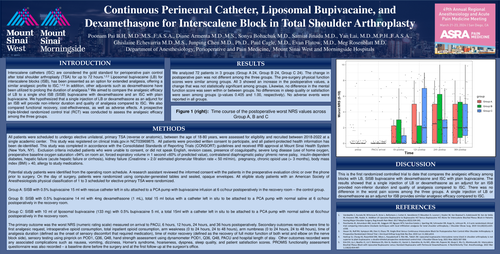
We analyzed 72 patients in 3 groups (Group A 24, group B 24, Group C 24). The change in postoperative pain was not different among the three groups. The pre-surgery physical function scores were similar among groups. All 3 showed an increase in the postoperative values, a change that was not statistically significant among groups. Likewise, no difference in the mental function score was seen within or between groups. No differences in sleep quality or satisfaction were seen among groups ( p-values 0.405 and 1.00, respectively). No adverse events were reported in all groups.
Discussion
This is the first randomized controlled trial to date that compares the analgesic efficacy among blocks with LB, SISB bupivacaine with dexamethasone and ISC with plain bupivacaine. The results showed that a single injection of LB or dexamethasone as an adjunct for an ISB provided non-inferior duration and quality of analgesia compared to ISC. There was no difference in the worst pain scores among the three groups.
A single injection of LB or dexamethasone as an adjunct for ISB provides similar analgesic efficacy compared to ISC.
References
1. Vandepitte C, Kuroda M, Witvrouw R, Anne L, Bellemans J, Corten K, Vanelderen P, Mesotten D, Leunen I, Heylen M, Van Boxstael S, Golebiewski M, Van de Velde M, Knezevic NN, Hadzic A. Addition of Liposome Bupivacaine to Bupivacaine HCl Versus Bupivacaine HCl Alone for Interscalene Brachial Plexus Block in Patients Having Major Shoulder Surgery. Reg Anesth Pain Med. 2017 May/Jun;42(3):334-341. doi: 10.1097/AAP.0000000000000560. PMID: 28157791.
2. Panchamia JK, Amundson AW, Jacob AK, Sviggum HP, Nguyen NTV, Sanchez-Sotelo J, Sperling JW, Schroeder DR, Kopp SL, Johnson RL. A 3-arm randomized clinical trial comparing interscalene blockade techniques with local infiltration analgesia for total shoulder arthroplasty. J Shoulder Elbow Surg. 2019 Oct;28(10):e325-e338. doi: 10.1016/j.jse.2019.05.013. Epub 2019 Jul 26. PMID: 31353302.
3. Hasan SS, Rolf RH, Sympson AN, Eten K, Elsass TR. Single-Shot Versus Continuous Interscalene Block for Postoperative Pain Control After Shoulder Arthroplasty: A Prospective Randomized Clinical Trial. J Am Acad Orthop Surg Glob Res Rev. 2019 Jun 11;3(6):e014. doi: 10.5435/JAAOSGlobal-D-19-00014. PMID: 31588420; PMCID: PMC6738550.
4. Hattrup SJ, Chung AS, Rosenfeld DM, Misra L, Koyyalamudi V, Ritz ML, Tokish JM. Liposomal bupivacaine interscalene nerve block in shoulder arthroplasty is not superior to plain bupivacaine: a double-blinded prospective randomized control trial. J Shoulder Elbow Surg. 2021 Mar;30(3):587-598. doi: 10.1016/j.jse.2020.09.017. Epub 2020 Oct 9. PMID: 33045330.
5. Kim DH, Liu J, Beathe JC, Lin Y, Wetmore DS, Kim SJ, Haskins SC, Garvin S, Oxendine JA, Ho MC, Allen AA, Popovic M, Gbaje E, Wu CL, Memtsoudis SG. Interscalene Brachial Plexus Block with Liposomal Bupivacaine versus Standard Bupivacaine with Perineural Dexamethasone: A Noninferiority Trial. Anesthesiology. 2022 Mar 1;136(3):434-447. doi: 10.1097/ALN.0000000000004111. Erratum in: Anesthesiology. 2023 Feb 1;138(2):233. PMID: 35041742.