457 posters, 2 videos, 2 audios, 8 topics, 45 sessions, 401 authors, 265 institutions
ePostersLive by SciGen Technologies S.A. All rights reserved.
49th Annual Regional Anesthesiology and Acute Pain Medicine Meeting
March 21-23, 2024 | The Hilton Bayfront San Diego | San Diego, California

5396
LOCAL ANESTHETIC ASSOCIATED DEATHS: AN FDA ADVERSE EVENT REPORTING SYSTEM SCREEN
Poster Presenter
Authors
Affiliations
Part of Topic
Scientific Abstracts > Regional Anesthesia
Local anesthetic associated deaths: An FDA adverse event reporting system screen
Michael R. Fettiplace
Introduction: Local anesthetic systemic toxicity (LAST) is a rare but serious complication of local anesthetic use with reports from the past 100 years1,2 identifying the potential risk of death associated with LAST. Quantifying and qualifying the risk is challenging due to the rarity and iatrogenic nature of this complication. One tool to investigate drug complications is the FDA adverse events reporting (FAER) database.
Methods: This study was exempted from review from University of Illinois Chicago institutional review board as it qualified as non-human subject research (STUDY2023-1546). The FAER database was queried on December 10th 2023 for five of the most commonly used local anesthetics in practice: (lidocaine, bupivacaine, ropivacaine, mepivacaine and chloroprocaine) using the following terms for each agent: “Bupivacaine (G)”,“Bupivacaine Hydrochloride (G)”, “Bupivacaine Hydrochloride\Epinephrine(G)”, “Bupivacaine\Epinephrine (G)”, “Bupivacaine Hydrochloride\Epinephrine Hydrochloride(G); “Ropivacaine (G), “Ropivacaine Hydrochloride (G)”, “Epinephrine\Ropivacaine”, “Epinephrine\Ropivacaine Hydrochloride (G)”, “Ropivacaine Hydrochloride Anhydrous (G)”; “Lidocaine (G)”, “Lidocaine Hydrochloride (G)”, “Lidocaine Carbonate (G)”, “Epinephrine\Lidocaine”, “Epinephrine\Lidocaine Hydrochloride (G)”; “Mepivacaine Hydrochloride (G)”, “Epinephrine\Mepivacaine (G)”, “Epinephrine\Mepivacaine Hydrochloride (G)”, “Mepivacaine Hydrochloride\Norepinephrine Bitartrate (G)”; “Chloroprocaine (G)”, “Chloroprocaine Hydrochloride (G)”. Records were included if the side effect was “serious”, reported by a “healthcare professional” and “died” was an outcome. Items were further screened if the drug of interest (common name or trade name) was included as the “Suspect Product Names” or named in the “Suspect Product Active Ingredient” column in isolation, another local anesthetic or combined with epinephrine. Secondary analysis was performed by bupivacaine splitting into liposomal bupivacaine and plain bupivacaine. For temporal analysis, events from the past ten years (2014 – 2023) were analyzed and compared to events reported prior to 2014 using Fisher exact test. Frequent “reason for use” and “reactions” were tabulated along with age and gender.
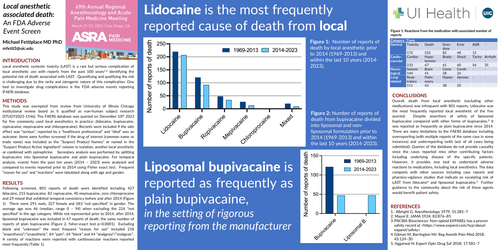
Results: Following screened, 801 reports of death were identified including 427 lidocaine, 215 bupivacaine, 82 ropivacaine, 40 mepivacaine, zero chloroprocaine and 29 mixed that exhibited temporal consistency before and after 2014 (Figure 1). There were 291 male, 327 female and 183 “not specified” in gender. The average age was 46 (median, range 0 – 94) when excluding the 226 “not specified” in the age category. While not represented prior to 2014, after 2014, liposomal bupivacaine was included in 47 reports of death, the same number of reports of plain bupivacaine (Figure 2, fisher-exact test p<0.0001). Excluding blank and “unknown” the most frequent “reason for use” included 218 “anaesthesia”/”anaesthetic”, 84 “pain”, 64 “block” and 44 “analgesia”/”analgesic”. A variety of reactions were reported with cardiovascular reactions reported most frequently (Table 1).
Conclusions: Overall, death from local anesthetic (excluding other medications) was infrequent with 801 reports. Lidocaine was the most frequently reported local anesthetic of the five queried. Despite assertions of safety of liposomal bupivacaine compared with other forms of bupivacaine,3 it was reported as frequently as plain bupivacaine since 2014. There are many limitations to the FAER database including overreporting (with multiple reports of the same case in some instances) and underreporting (with lack of all cases being submitted). Queries of the database do not provide causality since the cases reported miss other contributing factors including underlying disease of the specific patients. However, it provides one tool to understand adverse reactions to medications, including local anesthetics. The data comports with other sources including case reports and pharmco-vigilance studies that indicate an escalating risk of LAST from lidocaine4 and liposomal bupivacaine.5 Further guidance to the community about the risk of these agents would benefit patient safety.
References
1. Albright G: Cardiac Arrest Following Regional Anesthesia with Etidocaine or Bupivacaine. Anesthesiology 1979; 51:285–7
2. Mayer E: The Toxic Effects Following the Use of Local Anesthetics: An Analysis of the reports of Forty-Three Deaths Submitted to the Committee for the study of Toxic Effects of Local Anesthetics of the American Medical Association, and the Recommendations of the C. JAMA 1924; 82:876–85
3. PACIRA Biosciences: Non-opioid EXPAREL has a proven safety record at <https://www.exparel.com/hcp/about-exparel/safety>
4. Gitman M, Barrington MJ: Local Anesthetic Systemic Toxicity: A Review of Recent Case Reports and Registries. Reg Anesth Pain Med 2018; 43:124–30
5. Aggarwal N: Local anesthetics systemic toxicity association with exparel (bupivacaine liposome)- a pharmacovigilance evaluation. Expert Opin Drug Saf 2018; 17:581–7