457 posters, 2 videos, 2 audios, 8 topics, 45 sessions, 401 authors, 265 institutions
ePostersLive by SciGen Technologies S.A. All rights reserved.
49th Annual Regional Anesthesiology and Acute Pain Medicine Meeting
March 21-23, 2024 | The Hilton Bayfront San Diego | San Diego, California

5291
EFFECTS OF PERIOPERATIVE DRONABINOL USE IN TOTAL KNEE ARTHROPLASTY
Poster Presenter
Authors
Affiliations
Part of Topic
Scientific Abstracts > Regional Anesthesia
#5291 “Effects of Perioperative Dronabinol Use in Total Knee Arthroplasty”
Thor, P.1, Perlstein, M.5, Illescas, A.1, Lauzadis, J.1,3, Sheetz, M.1, Tailor, M.1, Puglisi, A.1, Popovic, M.1, Oxendine, J.1, Lin, Y.1, Kirksey, M.1, YaDeau, J.1, Kumar, K.1, Baaklini, L.1, Liu, J.1, Cheng, S.1,2, Mayman, D.4, Jerabek, S.4, Westrich, G.4, Cushner, F.4, Cross, M.4, Sculco, P.4, Sculco, T.4, Ast, M.4, Gonzalez-Della Valle, A.4, Sideris, A.1,2,3 & Jules-Elysee, K.M.1,2
1 Department of Anesthesiology, Critical Care, & Pain Management, Hospital for Special Surgery, New York, NY, USA
2 Department of Anesthesiology, Weill Cornell Medicine, New York, NY, USA
3 Pain Prevention Research Center, Hospital for Special Surgery, New York, NY, USA
4 Department of Orthopedic Surgery, Adult Reconstruction and Joint Replacement Surgery, Hospital for Special Surgery, New York, NY, USA
5 Yale New Haven Health, Greenwich Hospital, Greenwich, CT
Introduction
- Dronabinol is a synthetic tetrahydrocannabinol (D9-THC) agent FDA approved for chemotherapy-induced nausea and vomiting, and as an appetite stimulant for patients suffering from HIV or AIDS. Studies suggest that cannabinoids may have analgesic properties, making them potential alternatives for managing chronic pain conditions, such as neuropathic pain.
- Retrospective research on perioperative dronabinol indicated it may reduce opioid intake and shorten hospital stays for joint arthroplasty patients. In addition to alleviating acute pain, D 9-THC may also enhance respiration and impact the apnea-hypopnea index.
- Post-operative pain management following TKA can be effectively managed on the first day after surgery with a multimodal pain regimen including regional anesthesia techniques. Patients often experience a resurgence of pain the day following surgery, especially as nerve blocks wear off and they engage in activities and ambulation.
Methods
- A double-blind, placebo-controlled trial (IRB#2019-1416, NCT#04734080) assessed the possible opioid-sparing effect of perioperative dronabinol in TKA patients.
- The primary outcome was opioid consumption (in oral morphine equivalents) 24-48 hours after surgery (powered to detect a 30% decrease). Additional secondary outcomes included cumulative opioid requirements through POD 2, pain during ambulation on POD 2, number of oxygen desaturation events, and sleep quality.
- Eligible TKA patients were enrolled between March 8th, 2021, and October 4th, 2023. A total of 114 participants were recruited and randomized to either the placebo group (sesame oil capsules), or dronabinol group.
- The dronabinol group received 5mg active capsules twice per day for a total of five doses, beginning in the preoperative period and concluding on POD 2. The placebo group received same-sized and colored capsules in the same dosing regimen.
- Categorical variables reported as frequencies and percentages and compared using chi-square tests. Continuous variables reported as mean and standard deviation or median and interquartile range and compared using t-test or Mann-Whitney U tests. P-values less than 0.05 were statistically significant.
Results
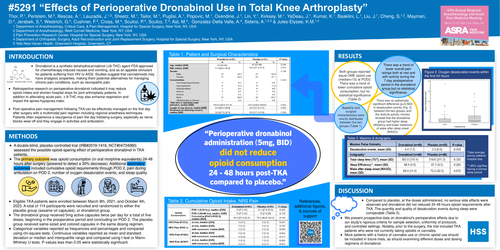
- Both groups reported equal OME opioid use (median=15) at POD2. There was a trend of lower cumulative opioid consumption, but no statistical significance (Table 2).
- There was a trend of lower overall pain ratings both at rest and with activity during the 7-day postoperative period in the dronabinol group but no statistical significance.
- Baseline and surgical characteristics were evenly distributed between the two groups (Table 1).
- There was no statistically significant difference (p=0.582) in desaturation events (Fig. 2) between the two groups, and the ActiLife activity monitor showed that the dronabinol group had higher sleep efficiency and lower instances of wake after sleep onset (WASO).
Discussion
- Compared to placebo, at the doses administered, no serious side effects were observed and dronabinol did not reduce 24-48 hours opioid requirements after TKA. The quantity and quality of desaturation events during sleep were comparable (Table 3).
- We present prospective data on dronabinol's perioperative effects due to our study's rigorous criteria for sample selection, uniformity of protocols, and controlled settings. Notably, prior to the surgery, the trial included TKA patients who were not currently taking opioids or cannabis.
- More patients with a history of cannabis use or chronic opioid use should be included in future trials, as should examining different doses and dosing regimens of dronabinol.