457 posters, 2 videos, 2 audios, 8 topics, 45 sessions, 401 authors, 265 institutions
ePostersLive by SciGen Technologies S.A. All rights reserved.
49th Annual Regional Anesthesiology and Acute Pain Medicine Meeting
March 21-23, 2024 | The Hilton Bayfront San Diego | San Diego, California

5174
JOURNEY TO THE CENTRE OF THE ARMPIT: MAPPING AXILLARY SENSORY CUTANEOUS NERVES FOR ENHANCED ANALGESIC APPROACHES IN BREAST SURGERY
Poster Presenter
Authors
Affiliations
Part of Topic
Scientific Abstracts > Regional Anesthesia
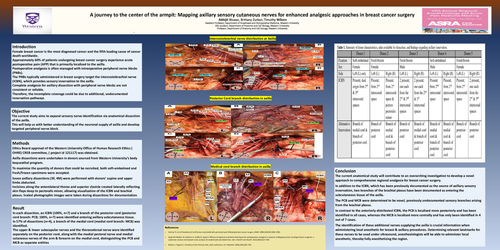
Introduction: Female breast cancer is the most diagnosed cancer and the fifth leading cause of cancer death worldwide.Approximately 60% of patients undergoing breast cancer surgery experience acute postoperative pain (APP) that is primarily localized to the axilla.Postoperative analgesia is often managed with intraoperative peripheral nerve blocks (PNBs).The PNBs typically administered in breast surgery target the intercostobrachial nerve (ICBN), which provides sensory innervation to the axilla.Complete analgesia for axillary dissection with peripheral nerve blocks are not consistent or reliable.Therefore, the incomplete coverage could be due to additional, undocumented innervation pathways.
Objective: The current study aims to expand sensory nerve identification via anatomical dissection of the axilla.This will help us with better understanding of the neuronal supply of axilla and develop targeted peripheral nerve block.
Methods: Ethics Board approval of the Western University Office of Human Research Ethics ( OHRE) CREB committee, ( project id 121117) was obtained.Axilla dissections were undertaken in donors sourced from Western University’s body bequeathal program.To maximize the quantity of donors that could be recruited, both soft-embalmed and fresh/frozen specimens were accepted. Seven axillary dissections (3F, 4M) were performed with donors’ supine and upper limbs abducted. Incisions along the anterolateral thorax and superior clavicle created laterally reflecting skin flaps deep to pectoralis minor, allowing visualization of the ICBN and brachial plexus. Scaled photographic images were taken during dissections for documentation.
Result: In each dissection, an ICBN (100%, n=7) and a branch of the posterior cord (posterior cord branch: PCB; 100%, n=7) were identified entering axillary subcutaneous tissue.In 57% of dissections (n=4), a branch of the medial cord (medial cord branch: MCB) was identified.The upper & lower subscapular nerves and the thoracodorsal nerve were identified separately on the posterior cord, along with the medial pectoral nerve and medial cutaneous nerves of the arm & forearm on the medial cord, distinguishing the PCB and MCB as separate entities.
Conclusion: The current anatomical study will contribute to an overarching investigation to develop a novel approach to comprehensive regional analgesia for breast cancer surgery. In addition to the ICBN, which has been previously documented as the source of axillary sensory innervation, two branches of the brachial plexus have been documented as entering the subcutaneous tissue of the axilla.The PCB and MCB were determined to be novel, previously undocumented sensory branches arising from the brachial plexus. In contrast to the anteriorly-distributed ICBN, the PCB is localized more posteriorly and has been identified in all cases, whereas the MCB is localized more centrally and has only been identified in 4 out of 7 cases. The identification of these additional nerves supplying the axilla is crucial information when administering local anesthetic for breast & axillary procedures. Determining relevant landmarks for these nerves to be used under ultrasound, anesthesiologists will be able to administer local anesthetic, thereby fully anesthetizing the region.
References