457 posters, 2 videos, 2 audios, 8 topics, 45 sessions, 401 authors, 265 institutions
ePostersLive by SciGen Technologies S.A. All rights reserved.
49th Annual Regional Anesthesiology and Acute Pain Medicine Meeting
March 21-23, 2024 | The Hilton Bayfront San Diego | San Diego, California

5156
COMPARING 2 DIFFERENT SUPERFICIAL PARASTERNAL INTERCOSTAL PLANE BLOCK TECHNIQUES ON THE SAME PATIENT
Poster Presenter
Authors
Affiliations
Part of Topic
Scientific Abstracts > Regional Anesthesia
Abstract: 5156
Scientific Abstracts > Regional Anesthesia
Comparing 2 different superficial parasternal intercostal plane block techniques on the same patient
Brian Greathouse, Jacob Loyd University of Colorado School of Medicine
Introduction
There are a number of studies demonstrating the efficacy of the superficial parasternal intercostal plane block (SPIPB) and deep parasternal intercostal plane block (DPIPB) for analgesia following sternotomy in cardiothoracic surgery.(1,2) When the SPIPB and DPIPB were compared, there was shown to be similar analgesic efficacy between the 2 blocks.(3) However, the SPIPB needle target is further from the internal thoracic artery, pleura, and the heart, and therefore, it carries a lower theoretical risk for complications compared to the DPIPB approach.(3) Of note, there is a paucity of comparison studies to elucidate the ideal block technique for the SPIPB.(1,2) Our case involved postoperative pain management for a patient who underwent a primary and then a re-do sternotomy almost a week apart. Given the favorable safety profile of the SPIPB, our team decided to perform a variation of the described SPIPB technique for each block. We feel that the ease and efficacy of our block approaches warrant discussion for how this block can be performed in the future.
Materials and Methods
Patient informed consent was obtained, including our plan for poster submission. This case report does not contain any patient identifiable information; therefore, it is exempt from IRB review as per Colorado Multiple Institutional Review Board (COMIRB) policy.
Results/Case Report
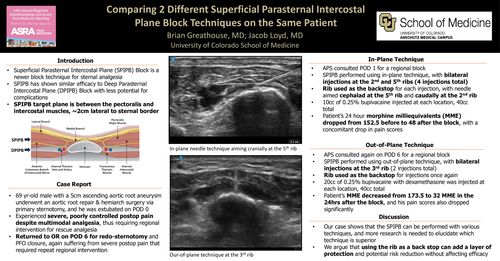
A 69-year-old male with past medical history of rheumatoid arthritis and a 5cm ascending aortic root aneurysm underwent aortic root repair and hemiarch surgery via primary sternotomy and was then extubated on postoperative day 0. Our Acute Pain Service (APS) team was consulted 18 hours postoperatively for poorly controlled pain and high opioid requirements. The patient had been receiving oxycodone, acetaminophen, ketorolac, fentanyl, and IV hydromorphone patient controlled analgesia. Our team performed a SPIPB with an in-plane needle approach at the 2nd and 5th ribs bilaterally. The injections at the 2nd rib were aimed caudally and then we aimed cranially at the level of the 5th rib. For each injection, the pecto-intercostal fascial plane was accessed using the rib as a backstop for the needle, and confirmation of adequate spread was verified when the pectoral muscles lifted off the intercostal muscles and the rib.(Image 1) A total of 40cc of local was injected, with 10 cc of 0.25% bupivacaine deposited at each of the 4 locations. In the 24 hours after the block, the patient’s daily morphine milliequivalents (MME) decreased to 48 MME,
compared to 152.5 MME before the block. The patient's pain scores also decreased dramatically.
Six days following the initial surgery, the patient returned to the operating room for redo sternotomy and PFO closure. Again, APS was consulted for poor pain control and high postoperative opioid usage. Another SPIPB was performed, however, this time with only one injection location per side at the 3rd rib, which was estimated to be the cephalo- caudal midpoint of the incision. The needle was advanced out-of-plane using the rib as a backstop for the needle, with the injection of local effectively spreading within the pecto-intercostal plane.(Image 2) A total of 40 cc of 0.25% bupivacaine with 5 mg of dexamethasone was injected, using 20cc per side. The patient’s opioid requirement decreased from 173.5 MME prior to the block to 32MME in the 24 hours following the block, with a corresponding drop in the patient's pain scores.
Discussion
The decrease in opioid consumption and improved pain scores suggest that both of our block techniques provided effective post-sternotomy analgesia. Theoretically, the 4 injection approach may ensure better local anesthetic spread compared to a single injection per side, given the possible disruption of tissue planes from surgical trauma. However, the additional injections come at the increased risk for complications, as well as more potential for patient discomfort during the procedure. Alternatively, the bilateral mid-incision injection appeared to provide comparable and adequate analgesia with fewer needle punctures. A confounding factor when comparing our 2 block techniques was the addition of dexamethasone with the single injections bilaterally. While this should not have affected the block's density, it may have increased the block duration, thus it possibly contributed to the decrease in overall opioid usage in the 24 hours post-block.
Perhaps most interesting is how our block techniques differed from the most commonly described SPIPB approach.(3) We argue that by using the rib as the backstop in each of our SPIPB approaches, we ensured maximal safety and ease of execution. Prior studies describe the SPIPB approach with the needle in plane, directed cranially, roughly 2cm lateral to the sternum, with the needle tip accessing the pecto-intercostal fascial plane in the interspace between the 4th and 5th ribs. With this approach, the pleura or pericardium could be violated if the needle were to travel deeper than intended.(3) The risk of pleural or pericardial puncture is potentially even greater with the DPIPB, which aims to inject local anesthetic at the same insertion site between the 4th and 5th ribs, but with a deeper target fascial plane between the transversus thoracis and intercostal muscle planes. Given the superficial approach and using the rib as the backstop for the needle, our technique is very similar to that of the Erector Spinae Plane block, which has gained in popularity recently due to its ease and utility.(4)
The unique opportunity to attempt and compare two different SPIPB approaches on the same patient spurs the discussion that there may be safer and equianalgesic techniques when performing an SPIPB. Our case demonstrated a slight variation that provided an easy and effective block with a theoretically lower risk profile. Our patient’s positive outcomes will hopefully spur further studies comparing different needle insertion sites and targets within the pecto-intercostal plane in order to elucidate which approach is superior.