457 posters, 2 videos, 2 audios, 8 topics, 45 sessions, 401 authors, 265 institutions
ePostersLive by SciGen Technologies S.A. All rights reserved.
49th Annual Regional Anesthesiology and Acute Pain Medicine Meeting
March 21-23, 2024 | The Hilton Bayfront San Diego | San Diego, California

5090
HIP ARTHROPLASTY LOW CONCENTRATION LOCAL ANESTHETIC FASCIA ILIACA BLOCK (HALF): A PILOT CASE SERIES
Poster Presenter
Authors
Affiliations
Part of Topic
Scientific Abstracts > Regional Anesthesia
Hip Arthroplasty Low Concentration Local Anesthetic Fascia Iliaca Block (HALF): A pilot case series
Introduction
Suprainguinal fascia iliaca blocks (SIFIB) have demonstrated effective analgesia and reduces opioid requirement in the first 24 hours following total hip arthroplasty (THA), although at the cost of femoral and obturator motor block. Moderate to high concentration long-acting local anaesthetic (LA) drugs traditionally used contribute to effective analgesia and also motor blockade.
Low concentration (LC) LA (<0.1%) are standard practice in labour epidurals with the aim of providing adequate analgesia whilst avoiding motor blockade. There are no published prospective trials evaluating low concentration LA blocks for THA assessing adequacy of analgesia with motor preservation.
Methods
This is a pilot case series of 6 patients having primary THA. They received pre-operative LC LA SIFIB with 0.075% ropivacaine with epinephrine 1:200000, 50mL. This was coupled with standardised spinal anesthesia (mepivacaine 2% 3.5mL with fentanyl 15mcg and morphine 100mcg). All other aspects of care were as per usual standard at one institution.
Patients were assessed at 4, 8, 24 and 48hours following spinal for the primary outcomes of pain scores at rest and movement (numerical verbal scale), opioid consumption (oral morphine equivalents) and secondary outcome of quadriceps weakness (Oxford Scale).
Results
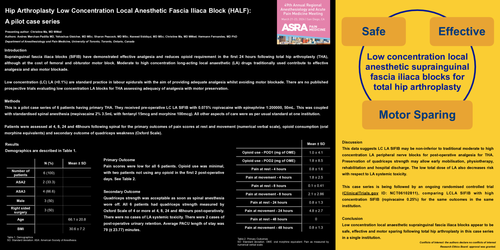
Demographics are described in Table 1.
Primary Outcome
Pain scores were low for all 6 patients. Opioid use was minimal, with two patients not using any opioid in the first 2 post-operative days. See Table 2.
Secondary Outcome
Quadriceps strength was acceptable as soon as spinal anesthesia wore off. All 6 patients had quadriceps strength measured by Oxford Scale of 4 or more at 4, 8, 24 and 48hours post-operatively. There were no cases of LA systemic toxicity. There were 2 cases of post-operative urinary retention. Average PACU length of stay was 79 (± 23.77) minutes.
Discussion
This data suggests LC LA SIFIB may be non-inferior to traditional moderate to high concentration LA peripheral nerve blocks for post-operative analgesia for THA. Preservation of quadriceps strength may allow early mobilisation, physiotherapy, rehabilitation and hospital discharge. The low total dose of LA also decreases risk with respect to LA systemic toxicity.
This case series is being followed by an ongoing randomised controlled trial (ClinicalTrials.gov ID: NCT06102811), comparing LCLA SIFIB with high concentration SIFIB (ropivacaine 0.25%) for the same outcomes in the same institution.
Conclusion
Low concentration local anaesthetic suprainguinal fascia iliaca blocks appear to be safe, effective and motor sparing following total hip arthroplasty in this case series in a single institution.