457 posters, 2 videos, 2 audios, 8 topics, 45 sessions, 401 authors, 265 institutions
ePostersLive by SciGen Technologies S.A. All rights reserved.
49th Annual Regional Anesthesiology and Acute Pain Medicine Meeting
March 21-23, 2024 | The Hilton Bayfront San Diego | San Diego, California

5189
GEOSPATIAL AND DEMOGRAPHIC ANALYSIS OF ACCESS TO FEMORAL NERVE BLOCK TO TOTAL KNEE ARTHROPLASTY ACROSS THE UNITED STATES
Poster Presenter
Authors
Affiliations
Part of Topic
Scientific Abstracts > Regional Anesthesia
Geospatial and Demographic Analysis of Access to Femoral Nerve Block to Total Knee Arthroplasty Across the United States
Tarika D. Patel MA BS1, Nafisa Mostofa BS1, Aksal Vashi BS1, Cheng-Ting Lee MD2
1Carle Illinois College of Medicine, University of Illinois Urbana Champaign, 2Department of Anesthesiology, Carle Foundation Hospital
INTRODUCTION
Approximately half of total knee arthroplasty (TKA) patients experience extreme pain after surgery, which is particularly difficult to treat.[1] The use of femoral nerve blocks (FNB) has proven to provide excellent postoperative analgesia, faster recovery times, and decreased opioid use and hospital costs.[2,3] Previous studies have demonstrated that the method of anesthesia received for TKAs can be influenced by race/ethnicity and socioeconomic status.[4] There appears to be an inequality among those who can receive regional anesthesia, favoring Caucasians and those with a high median income.[5] Additionally, primary payment supported by government programs or private insurance and service in metropolitan areas or freestanding surgical facilities lead to a higher likelihood of receiving regional anesthesia.[6] However, such studies don’t look at differences in nerve block use stratified by regional populations across the United States or the characterization of the populations themselves.
Aims
METHODS
Open-access databases were used to collect data for the years 2017-2021
Python was utilized for database building and data cleaning. GeoDa5 (a statistical map-based graphing software) was used to plot and assess demographic, geographic, and socioeconomic trends. Multivariate logistic regressions were performed to assess and control for confounding variables. Moran’s I, or global Moran’s I, was used to measure the similarity of a FIPS area code to its neighbors and to provide statistical significance of these spatial patterns. Spatial clusters that were identified were broken down into four groups of spatial outliers (High-High, High-Low, Low-High, and Low-Low) referencing the area’s relationship with its neighbors. Factorial ANOVA was performed to identify significant demographic variables within the cluster analysis groupings and a t-test was performed specifically between High-High and Low-Low clusters.
RESULTS
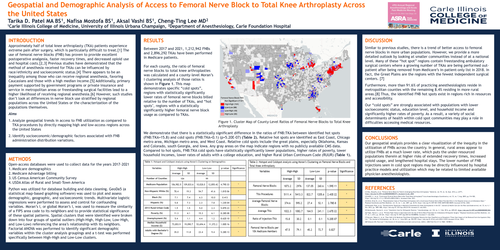
Between 2017 and 2021, 1,212,942 FNBs and 2,896,292 TKAs have been performed in Medicare patients. For each county, the ratio of femoral nerve blocks to total knee arthroplasties was calculated and a county-level Moran’s I clustering analysis of those ratios is shown in Figure 1. This map demonstrates specific “cold spots”, regions with statistically significantly lower rates of femoral nerve blocks billed relative to the number of TKAs, and “hot spots", regions with a statistically significantly higher femoral nerve block usage as compared to TKAs.
We demonstrate that there is a statistically significant difference in the ratios of FNB:TKA between identified hot spots (FNB:TKA=15.8) and cold spots (FNB:TKA=0.1) (p=5.20E-07) (Table 2). Relative hot spots are identified as East Coast, Chicago metro area, Michigan metro area, and West Coast. Relative cold spots include the great plains, especially Oklahoma, Kansas and Colorado, south Georgia, and Iowa. Any gray areas on the map indicate regions with no publicly available CMS data. Compared to hot spots, FNB:TKA cold spots have statistically significantly lower populations, higher rates of poverty, lower household incomes, lower rates of adults with a college education, and higher Rural Urban Continuum Code (RUUR) (Table 1).
DISCUSSION
Similar to previous studies, there is a trend of better access to femoral nerve blocks in more urban populations. However, we provide a more detailed outlook by looking at smaller communities instead of at a national level. Many of these “hot spot” regions contain freestanding ambulatory surgical centers where a growing number of TKAs are being performed out-patient after being removed from Medicare’s in-patient-only list in 2018. In fact, the Great Plains are the regions with the fewest independent surgical centers. [7]
Furthermore, more than 91.6% of practicing anesthesiologists reside in metropolitan counties with the remaining 8.4% residing in more rural areas.[8] Thus, the identified FNB hot spots exist in regions rich in resources and accessibility.
Our “cold spots” are strongly associated with populations with lower socioeconomic status, education level, and household income and significantly higher rates of poverty. As a result, a variety of social determinants of health within cold spot communities may play a role in difficulties accessing medical resources.
CONCLUSIONS
Our geospatial analysis provides a clear visualization of the inequity in the utilization of FNBs across the country. In general, rural areas appear to utilize FNBs at a much lower rate, which puts the under-resourced populations therein at higher risks of extended recovery times, increased opioid usage, and lengthened hospital stays. The lower number of FNB injections seen in cold spot regions may be directly influenced by hospital practice models and utilization which may be related to limited available physician anesthesiologists.
REFERENCES
[1] Heo, Bong Ha, et al. “Femoral Nerve Block for Patient Undergoing Total Knee Arthroplasty.” Medicine, vol. 95, no. 36, Sept. 2016, p. e4771, https://doi.org/10.1097/md.0000000000004771. Accessed 16 Jan. 2020.
[2] KADIC, L., et al. “Continuous Femoral Nerve Block after Total Knee Arthroplasty?” Acta Anaesthesiologica Scandinavica, vol. 53, no. 7, Aug. 2009, pp. 914–920, https://doi.org/10.1111/j.1399-6576.2009.01965.x. Accessed 4 Mar. 2021.
[3] Ilfeld, Brian M., et al. “Hospitalization Costs of Total Knee Arthroplasty with a Continuous Femoral Nerve Block Provided Only in the Hospital versus on an Ambulatory Basis.” Regional Anesthesia and Pain Medicine, vol. 32, no. 1, Jan. 2007, pp. 46–54, https://doi.org/10.1097/00115550-200701000-00009. Accessed 24 Feb. 2020.
[4] Keneally, Ryan, et al. “Socioeconomic Disparities in Method of Anesthesia for Knee Arthroplasties in the US.” Journal of Health Care for the Poor and Underserved, vol. 33, no. 4, 1 Nov. 2022, pp. 1809–1820, https://doi.org/10.1353/hpu.2022.0139. Accessed 31 July 2023.
[5] Memtsoudis, Stavros G., et al. “Anesthetic Care for Orthopedic Patients.” Anesthesiology, vol. 124, no. 3, 1 Mar. 2016, pp. 608–623, https://doi.org/10.1097/aln.0000000000001004.
[6] Tighe, Patrick J., et al. “Primary Payer Status Is Associated with the Use of Nerve Block Placement for Ambulatory Orthopedic Surgery.” Regional Anesthesia and Pain Medicine, vol. 37, no. 3, 2012, pp. 254–261, https://doi.org/10.1097/aap.0b013e31824889b6. Accessed 11 July 2022.
[7] Burnett, Robert A., et al. “Over Half of All Medicare Total Knee Arthroplasty Patients Are Now Classified as an Outpatient-Three-Year Impact of the Removal from the Inpatient-Only List.” The Journal of Arthroplasty, vol. 38, no. 6, 1 June 2023, pp. 992–997, https://doi.org/10.1016/j.arth.2022.12.029. Accessed 18 Jan. 2024.
[8] Fallacaro MD, Ruiz-Law T. Distribution of US anesthesia providers and services. AANA J. 2004 Feb;72(1):9-14. PMID: 15098514.