457 posters, 2 videos, 2 audios, 8 topics, 45 sessions, 401 authors, 265 institutions
ePostersLive by SciGen Technologies S.A. All rights reserved.
49th Annual Regional Anesthesiology and Acute Pain Medicine Meeting
March 21-23, 2024 | The Hilton Bayfront San Diego | San Diego, California

5380
DOUBLE-BLINDED RANDOMIZED CONTROL TRIAL ON THE PECS II BLOCK IN ARTHROSCOPIC ROTATOR CUFF REPAIR WITH OPEN BICEPS TENODESIS
Poster Presenter
Authors
Affiliations
Keck School of Medicine of the University of Southern California
Part of Topic
Scientific Abstracts > Regional Anesthesia
A Prospective Double-Blinded Randomized Control Trial on the PECS II Block in Arthroscopic Rotator Cuff Repair with
Open Biceps Tenodesis
INTRO
•Rotator cuff repairs (RCR) often require an extra incision along the upper medial arm for an open biceps tenodesis, which invades the T2 dermatome.
•Interscalene nerve blocks offer effective post-operative pain control for patients undergoing rotator cuff repair but not for biceps tenodesis
•The addition of a PECS II block to a standard interscalene nerve block catheter in open biceps tenodesis has an unclear benefit.
METHODS
•Patients undergoing arthroscopic RCR with open biceps tenodesis were randomly assigned to two groups, as approved by our IRB.
•Group A: 20 mL 0.5% ropivacaine for interscalene block, 15 mL of 0.25% ropivacaine for PECS II block.
•Group B: 20 mL 0.5% ropivacaine for interscalene block, 15 mL of 0.9% normal saline for PECS II block.
•Primary outcome: VAS score at 6 hours post-block.
•Secondary outcomes: opioid usage during surgery and up to 6 hours after the block, VAS score on PACU arrival, and pain score and opioid use at 2 weeks postoperatively.
RESULTS
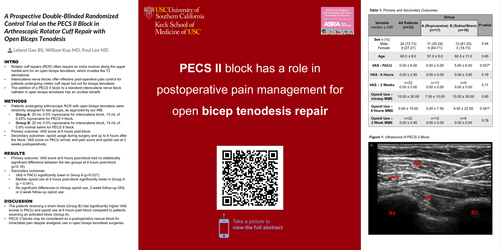
•Primary outcome: VAS score at 6 hours post-block had no statistically significant difference between the two groups at 6 hours post-block (p=0.19).
•Secondary outcomes:
•VAS in PACU significantly lower in Group A (p=0.027).
•Median opioid use at 6 hours post-block significantly lower in Group A (p = 0.041).
•No significant differences in intraop opioid use, 2-week follow-up VAS, or 2-week follow-up opioid use.
DISCUSSION
•The patients receiving a sham block (Group B) had significantly higher VAS scores in PACU and opioid use at 6 hours post-block compared to patients receiving an activated block (Group A).
•PECS 2 blocks may be considered as a postoperative rescue block for intractable pain despite analgesic use in open biceps tenodesis surgeries.