457 posters, 2 videos, 2 audios, 8 topics, 45 sessions, 401 authors, 265 institutions
ePostersLive by SciGen Technologies S.A. All rights reserved.
49th Annual Regional Anesthesiology and Acute Pain Medicine Meeting
March 21-23, 2024 | The Hilton Bayfront San Diego | San Diego, California

5442
COMPARISON OF GENICULAR NERVE BLOCK WITH ADDUCTOR CANAL BLOCK FOR ARTHROSCOPIC ANTERIOR CRUCIATE LIGAMENT RECONSTRUCTION
Poster Presenter
Authors
Affiliations
Part of Topic
Scientific Abstracts > Regional Anesthesia
Comparison of Genicular Nerve Block with Adductor Canal Block for Postoperative Pain Management in Adults undergoing
Arthroscopic Anterior Cruciate Ligament Reconstruction
INTRODUCTION
Genicular Nerve Block (GNB) is beneficial in early ambulation and faster patient discharge since it selectively blocks articular branches
and is motor-sparing. This study aimed to compare the analgesic efficacy of ultrasound (US) guided GNB with US-guided Adductor Canal Block (ACB)in patients undergoing arthroscopic Anterior Cruciate Ligament Reconstruction (AACLR).
METHODS
This randomized, double-blind study was conducted on 38 American Society of Anesthesiologists (ASA) I/II adults undergoing AACLR. In the operating room, spinal anesthesia was administered. Under all aseptic precautions, subarachnoid block was given at L3-L4 intervertebral space using a 25-gauge Quincke spinal needle using 10-15 mg ( 2.0 – 3.0 ml) of hyperbaric bupivacaine (0.5%) with 10µg fentanyl. The patient was then positioned supine. After administration of the spinal block, peripheral nerve blocks were administered as per the group allocation.
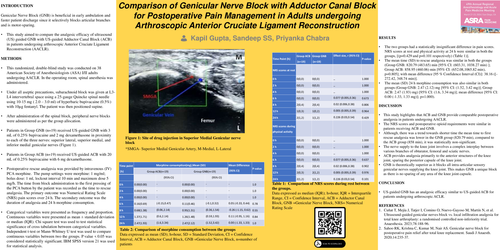
Patients in Group GNB (n=19) received US-guided GNB with 3 mL of 0.25% bupivacaine and 2 mg dexamethasone in proximity to each of the three nerves: superior lateral, superior medial, and inferior medial genicular nerves (Figure 1). Patients in Group ACB (n=19) received US-guided ACB with 20 mL of 0.25% bupivacaine with 6 mg dexamethasone. Postoperative rescue analgesia was provided by intravenous (IV) PCA morphine. The pump settings were morphine: 1 mg/ml; bolus dose: 1 ml, lockout interval 10 min and maximum dose 5 mg/h. The time from block administration to the first pressing of the PCA button by the patient was recorded as the time to rescue analgesia. The primary outcome was Numerical Rating Scale (NRS) pain scores over 24 h. The secondary outcome was the duration of analgesia and 24 h morphine consumption.
Categorical variables were presented as frequency and proportion. Continuous variables were presented as mean ± standard deviation or median (IQR). Chi square test was used to test statistical significance of cross tabulation between categorical variables. Independent t-test or Mann-Whitney U test was used to compare continuous variables between two the groups. P value < 0.05 was considered statistically significant. IBM SPSS version 21 was used for statistical analysis.
RESULTS
The two groups had a statistically insignificant difference in pain scores. NRS scores at rest and physical activity at 24 h were similar in both the
groups, [(p=0.429 and p=0.101 respectively) (Table 1)]. The mean time (SD) to rescue analgesia was similar in both the groups (Group GNB: 820.79 (483.65) min [95% CI: (603.31, 1038.27 min) ]; Group ACB: 858.95 (460.06) min [95% CI: (652.08,1065.82 min), p=0.805]; with mean difference [95 % Confidence Interval (CI)]: 38.16 ([-272.42, 348.74 min)]. The mean (SD) 24 h morphine consumption was also similar in both groups (Group GNB: 2.47 (2.12) mg [95% CI: (1.52, 3.42 mg)]; Group ACB: 2.47 (1.93) mg) [95% CI: (1.6, 3.34 mg)]; mean difference [95% CI: 0.00 (-1.33, 1.33 mg)]; p=1.000).
DISCUSSION
This study highlights that ACB and GNB provide comparable postoperative analgesia in patients undergoing AACLR. The NRS scores and postoperative opioid requirements were similar in atients receiving ACB and GNB. Although, there was a trend towards shorter time the mean time to first rescue analgesia was lower in the GNB group (820.79 min), compared to the ACB group (858 min), it was statistically non-significant. The nerve supply to the knee joint involves a complex interplay between various branches of obturator, femoral and sciatic nerves. ACB provides analgesia primarily to the anterior structures of the knee joint, sparing the posterior capsule of the knee joint. GNB is theoretically superior as it blocks all intra-articular sensory genicular nerves supplying the knee joint. This makes GNB a unique block as there is no sparing of any area of the knee joint capsule.
CONCLUSION
US-guided GNB has an analgesic efficacy similar to US-guided ACB for patients undergoing arthroscopic ACLR.
REFERENCES
Cuñat T, Mejía J, Tatjer I, Comino O, Nuevo-Gayoso M, Martín N, et al. Ultrasound-guided genicular nerves block vs. local infiltration analgesia for total knee arthroplasty: a randomised controlled non-inferiority trial. Anaesthesia. 2023;78:188-96.
Sahoo RK, Krishna C, Kumar M, Nair AS. Genicular nerve block for postoperative pain relief after total knee replacement. Saudi J Anaesth. 2020;14:235-37.