457 posters, 2 videos, 2 audios, 8 topics, 45 sessions, 401 authors, 265 institutions
ePostersLive by SciGen Technologies S.A. All rights reserved.
49th Annual Regional Anesthesiology and Acute Pain Medicine Meeting
March 21-23, 2024 | The Hilton Bayfront San Diego | San Diego, California

5445
GOOGLE SEARCH ANALYSIS: WHAT DO PEOPLE WANT TO KNOW ABOUT REGIONAL ANESTHESIA AND WHERE DO THEY FIND THE ANSWERS?
Poster Presenter
Authors
Affiliations
Part of Topic
Scientific Abstracts > Regional Anesthesia
Background
•93% of Americans are online in 20231 and Google has become the most utilized search engine in the world.2
•A review found that 52% of patients used the internet to acquire information before their elective procedures.3
•We aimed to identify the questions patients had about regional anesthesia and from where people acquired this information.
Methods
•We analyzed data from Google (www.google.com) using a search engine optimizer Ahrefs (www.ahrefs.com) to identify the most commonly used search terms about regional anesthesia.
•We limited data collected to the United States.
•We used search volume per month to determine popularity.
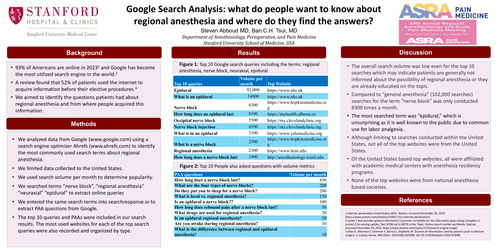
•We searched terms “nerve block”, “regional anesthesia” “neuraxial” “epidural” to extract online queries
•We entered the same search terms into searchresponse.io to extract PAA questions from Google.
•The top 10 queries and PAAs were included in our search results. The most used websites for each of the top search queries were also recorded and organized by type.
Discussion
•The overall search volume was low even for the top 10 searches which may indicate patients are generally not informed about the possibility of regional anesthesia or they are already educated on the topic.
•Compared to “general anesthesia” (102,000 searches) searches for the term ”nerve block” was only conducted 8300 times a month.
•The most searched term was “epidural,” which is unsurprising as it is well known to the public due to common use for labor analgesia.
•Although limiting to searches conducted within the United States, not all of the top websites were from the United States.
•Of the United States based top websites, all were affiliated with academic medical centers with anesthesia residency programs.
•None of the top websites were from national anesthesia based societies.