457 posters, 2 videos, 2 audios, 8 topics, 45 sessions, 401 authors, 265 institutions
ePostersLive by SciGen Technologies S.A. All rights reserved.
49th Annual Regional Anesthesiology and Acute Pain Medicine Meeting
March 21-23, 2024 | The Hilton Bayfront San Diego | San Diego, California

5546
PROSPECTIVE EVALUATION OF THE ON THE EFFECTIVENESS OF BRACHIAL PLEXUS NERVE BLOCK
Poster Presenter
Authors
Affiliations
UPMC, University of Pittsburgh Medical Center, Pittsburgh, PA
Part of Topic
Scientific Abstracts > Regional Anesthesia
Prospective Evaluation of the on the Effectiveness of Brachial Plexus Nerve Block
Yue Qiu MD†, Daniel Huettner MD †, Bedda L. Rosario BS, MPH, PhD *, and Steven Orebaugh MD†
ABSTRACT
Background
Addressing acute pain in opioid-tolerant patients poses challenges in perioperative care. Animal studies suggest that repeated opioid exposure reduces the potency of lidocaine in a dose-dependent and time-dependent manner 1. Currently, there is limited clinical evidence on the impact of chronic opioid use on the efficacy and duration of local anesthetics administered via peripheral nerve blocks 2 3 4. We investigated whether patients with chronic opioid use undergoing upper extremity surgery with a brachial plexus nerve block experience reduced block effectiveness.
Method
This prospective, observational, single-center study, which was approved by the Institutional Review Board (IRB, STUDY19010112). Patients undergoing upper extremity surgery requiring a brachial plexus nerve block were recruited. Candidates were defined as those who received opioids daily for one month preoperatively in the opioid group and those who did not receive preoperative opioids for 3 months prior to surgery as the control group. Interscalene or supraclavicular nerve blocks were performed depending on the upper extremity surgery with 0.5% ropivacaine or 0.5% bupivacaine. Upon discharge from the recovery area to home, the patient completed a pain diary recording pain scores and opioid use over the following 72 hours. The primary outcome was a PACU VAS score of more than 2 units higher in chronic opioid patients than those not opioid dependents. Secondary outcomes included opioid/dexmedetomidine/ketamine requirement in the OR, block duration, postoperative opioid requirement, and pain scores for three postoperative days.
Results
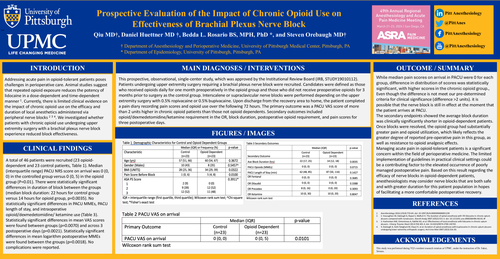
A total of 46 patients were recruited (23 opioid-dependent and 23 control patients, Table 1). Median (interquartile range) PACU NRS score on arrival was 0 (0, 0) in the controlled group versus 0 (0, 5) in the opioid group (P=0.01). There were statistically significant differences in duration of block between the groups (median block duration: 22 hours for control group versus 14 hours for opioid group, p=0.0035). No statistically significant differences in PACU MMEs, PACU length of stay, and intraoperative opioid/dexmedetomidine/ ketamine use (Table 3). Statistically significant differences in mean VAS scores were found between groups (p=0.0070) and across 3 postoperative days (p=0.0021). Statistically significant differences in mean logarithm postoperative MMEs were found between the groups (p=0.0018). No complications were reported.
Discussion
While median pain scores on arrival in PACU were 0 for each group, difference in distribution of scores was statistically significant, with higher scores in the chronic opioid group., Even though the difference is not meet our pre-determined criteria for clinical significance (difference >2 units). it is possible that the nerve block is still in effect at the moment that the patient arrives at PACU.
The secondary endpoints showed the average block duration was clinically significantly shorter in opioid-dependent patients. Once blocks were resolved, the opioid group had substantially greater pain and opioid utilization, which likely reflects the greater degree of reported pre-operative pain in this group, as well as resistance to opioid analgesic effects.
Managing acute pain in opioid-tolerant patients is a significant concern within the field of perioperative medicine. The limited implementation of guidelines in practical clinical settings could be a contributing factor to the elevated occurrence of poorly managed postoperative pain. Based on this result regarding the efficacy of nerve blocks in opioid-dependent patients, anesthesiologists may consider nerve blocks that are both safe and with greater duration for this patient population in hopes of facilitating a more comfortable postoperative recovery.
1. Liu Q, Gold MS. Opioid-induced Loss of Local Anesthetic Potency in the Rat Sciatic Nerve. Anesthesiology 2016;125(4):755-64. doi: 10.1097/ALN.0000000000001239
2. Vosoughian M, Dabbagh A, Rajaei S, Maftuh H. The duration of spinal anesthesia with 5% lidocaine in chronic opium abusers compared with nonabusers. Anesth Analg 2007;105(2):531-3. doi: 10.1213/01.ane.0000268496.46141.4f
3. Hashemian AM, Omraninava A, Kakhki AD, et al. Effectiveness of local anesthesia with lidocaine in chronic opium abusers. J Emerg Trauma Shock 2014;7(4):301-4. doi: 10.4103/0974-2700.142765
4. Dabbagh A, Dahi-Taleghani M, Elyasi H, et al. Duration of spinal anesthesia with bupivacaine in chronic opium abusers undergoing lower extremity orthopedic surgery. Arch Iran Med 2007;10(3):316-20.