457 posters, 2 videos, 2 audios, 8 topics, 45 sessions, 401 authors, 265 institutions
ePostersLive by SciGen Technologies S.A. All rights reserved.
49th Annual Regional Anesthesiology and Acute Pain Medicine Meeting
March 21-23, 2024 | The Hilton Bayfront San Diego | San Diego, California

5479
TRENDS IN COMORBIDITIES AND COMPLICATIONS IN OCTOGENARIANS AND NONAGENARIANS UNDERGOING TOTAL HIP AND KNEE ARTHROPLASTY
Poster Presenter
Authors
Affiliations
Part of Topic
Scientific Abstracts > Regional Anesthesia
Background
With an ever-increasing median age of total hip and knee arthroplasty (THA, TKA) recipients the proportion of patients aged 80+ and 90+ is likely to increase.
•These patients present unique challenges in terms of higher comorbidity burden, frailty and perioperative risks requiring a customized approach to healthcare to meet their unique needs.
•However, large scale data specifically characterizing these patient groups is lacking.
•The primary objective of this study was to offer an extensive overview of the variations in THA/TKA outcomes and practices across diverse age spectrums, with a specific focus on addressing the challenges posed by an aging population.
Methods
•We utilized the Premier Healthcare database to identify patients undergoing THA and TKA from 2006 to 2022 in two age groups: 80-88 years and ≥89 years.
•These two groups were then compared to those aged 65-70, the typical age group for THA/TKA recipients.
•We evaluated trends in proportion of octogenarian and nonagenarian and patient and hospital level characteristics, and perioperative complications, stratified by age groups.
•Subsequently, multivariable mixed-effects models were applied to compare octogenarian and nonagenarian patients to those aged 65-70 in terms of major complications (defined as having any complications including acute renal failure, delirium, myocardial infarction, pulmonary embolism, respiratory failure, cerebral complication and mortality during hospitalization).
•Estimates were presented as odds ratios (OR) and 95% CIs.
Results
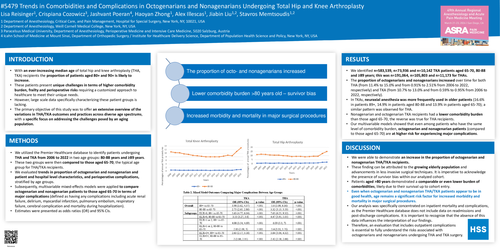
•We identified n=583,539, n=73,936 and n=10,142 TKA patients aged 65-70, 80-88 and ≥89 years; this was n=191,064, n=105,803 and n=11,173 for THAs.
•The proportion of octogenarians and nonagenarians increased over time for both THA (from 11.4% to 15.0% and from 0.91% to 2.51% from 2006 to 2022, respectively) and TKA (from 10.7% to 13.0% and from 0.59% to 0.95% from 2006 to 2022, respectively).
•In TKAs, neuraxial anesthesia was more frequently used in older patients (16.6% in patients 89+, 14.9% in patients aged 80-88 and 13.9% in patients aged 65-70); a similar pattern was observed for THA.
•Nonagenarian and octogenarian TKA recipients had a lower comorbidity burden than those aged 65-70, the reverse was true for THA recipients.
•Our multivariable models showed that even among patients who have the same level of comorbidity burden, octogenarian and nonagenarian patients (compared to those aged 65-70) are at higher risk for experiencing major complications.
Discussion
•We were able to demonstrate an increase in the proportion of octogenarian and nonagenarian THA/TKA recipients.
•These finding can be attributed to the growing elderly population and advancements in less invasive surgical techniques. It is imperative to acknowledge the presence of survivor bias within our analyzed cohort.
•Patients aged >80 years demonstrated a comparable or even lower burden of comorbidities, likely due to their survival up to cohort entry.
•Even when octogenarian and nonagenarian THA/TKA patients appear to be in good health, age remains a significant risk factor for increased morbidity and mortality in major surgical procedures.
•Our analysis was specifically concentrated on inpatient mortality and complications, as the Premier Healthcare database does not include data on readmissions and post-discharge complications. It is important to recognize that the absence of this data influences the interpretation of our findings.
•Therefore, an evaluation that includes outpatient complications is essential to fully understand the risks associated with octogenarians and nonagenarians undergoing THA and TKA surgery.