457 posters, 2 videos, 2 audios, 8 topics, 45 sessions, 401 authors, 265 institutions
ePostersLive by SciGen Technologies S.A. All rights reserved.
49th Annual Regional Anesthesiology and Acute Pain Medicine Meeting
March 21-23, 2024 | The Hilton Bayfront San Diego | San Diego, California

5435
IMPACT OF USING FASCIAL PLANE BLOCKS IN TOTAL MASTECTOMIES
Poster Presenter
Authors
Affiliations
Part of Topic
Scientific Abstracts > Regional Anesthesia
Impact Of Using Fascial Plane Blocks in Mastectomies and Flaps
Rayna Walburger, MD, Elizabeth Luebbert MD, Ghislaine Echevarria, MD, MS, Poonam Pai B.H MD, FASA
Introduction
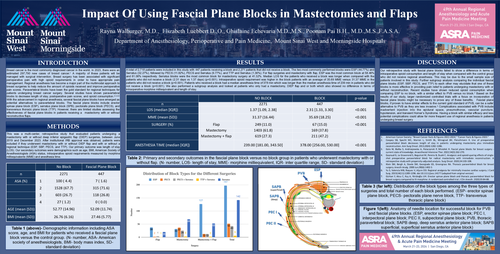
Breast cancer is the most commonly diagnosed cancer in the world. In 2023, there were an estimated 297,790 new cases of breast cancer.1 A majority of these patients will be managed with surgical intervention. Breast surgery has been associated with significant perioperative pain with high opioid requirements in order to have appropriate pain management. Regional anesthesia has become a major part of the multimodal approach to breast surgeries to help reduce the amount of opioids received and improve perioperative pain scores. Paravertebral blocks have been the gold standard for regional techniques for patients undergoing breast cancer surgery. Several studies have shown paravertebral blocks to decrease length of stay, postoperative pain scores, and opioid consumption.2,3,4,5 With the advancement in regional anesthesia, several fascial plane blocks have emerged as potential alternatives to paravertebral blocks. The fascial plane blocks include erector spinae plane block (ESP), serratus plane block (SPB), pectoralis plane block (PECS), and transversus thoracic plane block (TTP). However, there are limited studies assessing the effectiveness of fascial plane blocks in patients receiving a mastectomy with or without reconstructive flaps.
Materials and Methods
This was a multi-center, retrospective study that evaluated patients undergoing a mastectomy with or without deep inferior epigastric flap (DIEP) surgeries, between June 2019 and December 2023. After institutional IRB approval was obtained, patients were included if they underwent mastectomy with or without DIEP flap and with or without a regional technique (ESP, SBP, PECS, and TTP). Our primary outcome was length of stay (LOS). Our secondary outcomes were demographics such as age, BMI, American Society of Anesthesiologists (ASA) status, intraoperative opioid requirements measured by morphine milliequivalents (MME) and anesthesia time.
Results
A total of 2,718 patients were included in this study with 447 patients receiving a block and 2,271 patients that did not receive a block. The two most commonly performed blocks were ESP (44.77%) and Serratus (32.27%), followed by PECS (11.82%), PECS and Serratus (9.77%), and TTP and Serratus (1.36%). For flap surgeries and mastectomy with flap, ESP was the most common block at 58.46% and 61.06% respectively. Serratus blocks were the most common block for mastectomy surgery at 41.32%. Median LOS for the patients who received a block was longer when compared with the patients who did not receive a block (2.31 days vs 1.37 days) (p<0.001). Intraoperative opioid requirement was higher in the block patients with an average of 35.69 MME versus 31.37 MME in the patients who did not receive a block (p<0.001). Patients who received a block had a median anesthesia time of 378 min which was longer than the median anesthesia time of 239 min in patients who did not receive a block (p<0.001). We also performed a subgroup analysis and looked at patients who only had a mastectomy, DIEP flap and or both which also showed no difference in terms of intraoperative morphine milliequivalent and length of stay.
Discussions
Our retrospective study with fascial plane blocks failed to show a difference in terms of intraoperative opioid consumption and length of stay when compared with the control group who did not receive regional anesthesia. This may be due to the small sample size of patients involved in this study. Further subgroup analysis comparing the individual fascial plane blocks (ESP, SBP, PECS, and TTP) to each other may elucidate that one of these blocks is more effective in providing pain relief to patients undergoing mastectomy with or without reconstruction. Recent studies have shown reduced opioid consumption when comparing ESP to no block, with a similar effect to PVB versus no block.7 Based on the results of our study, larger randomized controlled trials with a focus on incorporation of fascial plane blocks might be necessary to prove any of these benefits. Fascial plane blocks, if proven to have similar effects to the current gold standard of PVB, can be a safer alternative to PVB as they are less invasive.3 Complications associated with PVB include inadvertent injection into the epidural space, pneumothorax, vascular puncture, hypotension, and transient Horner’s Syndrome. Having a block with similar efficacy and less potential complications could allow for more frequent use of regional anesthesia in patients undergoing breast surgery.
References
-
American Cancer Society: “Breast Cancer Facts & Figures 2022-2024,” “Cancer Facts & Figures 2023.”
-
Coopey SB, Specht MC, Warren L, Smith BL, Winograd JM, Fleischmann K. Use of preoperative paravertebral block decreases length of stay in patients undergoing mastectomy plus immediate reconstruction. Ann Surg Oncol. 2013;20(4):1282-1286. doi:10.1245/s10434-012-2678-7
-
Gola W, Białka S, Andrzejewska A, Palaczynski P, Misiołek H. Fascial plane blocks for breast surgery - current state of knowledge. Anaesthesiol Intensive Ther. 2022;54(3):262-270. doi:10.5114/ait.2022.119220
-
Gayraud G, Le Graverend S, Beguinot M, Pereira B, Dualé C. Analgesic and opioid-sparing effects of single-shot preoperative paravertebral block for radical mastectomy with immediate reconstruction: A retrospective study with propensity-adjusted analysis. Surg Oncol. 2020;34:103-108. doi:10.1016/j.suronc.2020.03.006
-
Klein SM, Bergh A, Steele SM, Georgiade GS, Greengrass RA. Thoracic paravertebral block for breast surgery. Anesth Analg. 2000 Jun;90(6):1402-5. doi: 10.1097/00000539-200006000-00026. PMID: 10825328.
-
Yu S, Valencia MB, Roques V, Aljure OD. Regional analgesia for minimally invasive cardiac surgery. J Card Surg. 2019;34(11):1289-1296. doi:10.1111/jocs.14177 (adapted from original version)
-
Gürkan Y, Aksu C, Kuş A, Yörükoğlu UH. Erector spinae plane block and thoracic paravertebral block for breast surgery compared to IV-morphine: A randomized controlled trial. J Clin Anesth. 2020;59:84-88. doi:10.1016/j.jclinane.2019.06.036