457 posters, 2 videos, 2 audios, 8 topics, 45 sessions, 401 authors, 265 institutions
ePostersLive by SciGen Technologies S.A. All rights reserved.
49th Annual Regional Anesthesiology and Acute Pain Medicine Meeting
March 21-23, 2024 | The Hilton Bayfront San Diego | San Diego, California

5505
ADDUCTOR AND SCIATIC PERIPHERAL NERVE CATHETERS FOR SCHATZKER VI TIBIAL PLATEAU FRACTURE
Poster Presenter
Authors
Part of Topic
Scientific Abstracts > Regional Anesthesia
Adductor and Sciatic Peripheral Nerve Catheters for Schatzker VI Tibial Plateau Fracture
Anna F. Roth, MD1, Shaun H. Medina, MD1, Camille G. Fontaine, MD1, Elilary Montilla, MD1
1. Department of Anesthesiology Montefiore/Albert Einstien College of Medicine
Introduction
Case Report
30 year-old F w no PMH who sustained a closed left Schatzker VI tibial plateau fracture following a Jet ski accident. Patient was initially treated at an outside institution where an external fixator was placed 3 weeks prior to presentation for a subsequent ORIF.
Preoperative lower extremity exam was unremarkable, Labs were notable for a hematocrit of 29.5% and platelet count of 484k/uL. All other labs were WNL.
Imaging was noted for a comminuted lateral tibia plateau fracture with multiple articular fragments, tibial spine fracture and medial tibia plateau fracture with impaction of the medial femoral condyle into a medial tibia plateau with widening of the tibial condyle.
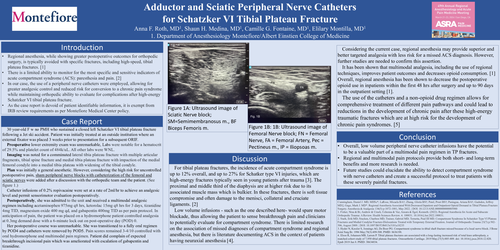
Plan was initially a general anesthetic. However, considering the high risk for uncontrolled postoperative pain, sham peripheral nerve blocks with catheterization of the femoral and sciatic nerves were added after a discussion with the orthopedic team and the patient. (See figure 1.)
Catheter infusions of 0.2% ropivacaine were set at a rate of 2ml/hr to achieve an analgesic level and permit sensorimotor evaluation postoperatively.
Postoperatively, she was admitted to the unit and received a multimodal analgesic regimen including acetaminophen 975mg q8 hrs, ketorolac 15mg q8 hrs for 3 days, tizanidine 4mg TID, magnesium oxide 400 mg qd, and gabapentin 400mg TID as per pain protocol. In anticipation of pain, the patient was placed on a hydromorphone patient controlled analgesia at 0.3mg demand dose with a 6-minute lock out on post-operative day (POD) 0.
Her postoperative course was unremarkable. She was transitioned to a fully oral regimen by POD4 and catheters were removed by POD5. Pain scores remained 3-4/10 controlled with oral hydromorphone and multimodal pain regimen. Patient did complain of expected breakthrough incisional pain which was ameliorated with escalation of gabapentin and tizanidine.
Discussion
For tibial plateau fractures, the incidence of acute compartment syndrome is up to 12% overall, and up to 27% for Schatker type VI injuries, which are high-energy fractures typically seen in young patients after trauma [3]. The proximal and middle third of the diaphysis are at higher risk due to its associated muscle mass which is bulkier. In these fractures, there is soft tissue compromise and often damage to the menisci, collateral and cruciate ligaments. [2]
Low volume infusions - such as the one described here- would spare motor blockade, thus allowing the patient to sense breakthrough pain and clinicians to potentially evaluate for compartment syndrome. There is limited research on the association of missed diagnoses of compartment syndrome and regional anesthesia, but there is literature documenting ACS in the context of patients having neuraxial anesthesia [4].
Considering the current case, regional anesthesia may provide superior and better targeted analgesia with less risk for a missed ACS diagnosis. However, further studies are needed to confirm this assertion.
It has been shown that multimodal analgesia, including the use of regional techniques, improves patient outcomes and decreases opioid consumption. [1] Overall, regional anesthesia has been shown to decrease the postoperative opioid use in inpatients within the first 48 hrs after surgery and up to 90 days in the outpatient setting [1].
The use of the catheters and a non-opioid drug regimen allows for comprehensive treatment of different pain pathways and could lead to reductions in the development of chronic pain after these high-energy traumatic fractures which are at high risk for the development of chronic pain syndromes. [5]
Conclusion