457 posters, 2 videos, 2 audios, 8 topics, 45 sessions, 401 authors, 265 institutions
ePostersLive by SciGen Technologies S.A. All rights reserved.
49th Annual Regional Anesthesiology and Acute Pain Medicine Meeting
March 21-23, 2024 | The Hilton Bayfront San Diego | San Diego, California

5392
THE EFFECT OF COMBINED INTRATHECAL DEXMEDETOMIDINE & LOCAL ANESTHETIC ON SPINAL ANESTHESIA: A SYSTEMATIC REVIEW AND META-ANALYSIS
Poster Presenter
Authors
Affiliations
Part of Topic
Scientific Abstracts > Regional Anesthesia
THE EFFECT OF COMBINED INTRATHECAL DEXMEDETOMIDINE & LOCAL ANESTHETIC ON SPINAL ANESTHESIA: A SYSTEMATIC REVIEW AND META-ANALYSIS
INTRODUCTION
•Dexmedetomidine, an α2-receptor agonist, has been used to enhance the conductive block effects of local anesthetics ( LA) in different regional anesthesia. Although this effect has been reported sporadically and systemically in the peripheral nerve blocks, a systemic review and meta-analysis of LA and dexmedetomidine mixture in the subarachnoid space is spared.
•We propose this study to examine the effecy and safety profile of different randomized control trials (RCTs) in which they used dexmedetomidine in addition to local anesthetics in their spinal anesthesia.
METHODS
•A systematic review and meta-analysis were performed according to the Preferred Reporting Items for Systematic Reviews and Meta-Analyses (PRISMA) guidelines. (PROSPERO # CRD42023481927).
•PubMed, Embase, Scopus and Cochrane databases were searched from inception to December 2023 using the keywords "(dexmedetomidine OR precedex) AND (spinal OR intrathecal) AND (randomised OR randomized) by two different authors.
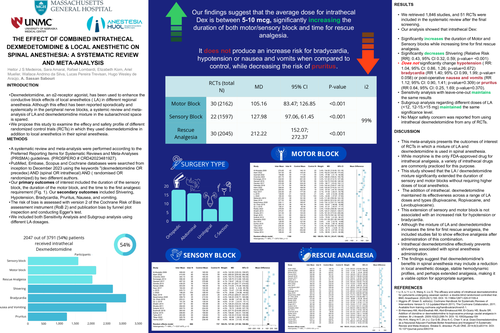
•Our primary outcomes of interest included the duration of the sensory block, the duration of the motor block, and the time to the first analgesic requirement (Fig. 1). Our secondary outcomes included Shivering, Hypotension, Bradycardia, Pruritus, Nausea, and vomiting.
•The risk of bias is assessed with version 2 of the Cochrane Risk of Bias assessment instrument (RoB 2) and publication bias by funnel plot inspection and conducting Egger's test.
•We included both Sensitivity Analysis and Subgroup analysis using different LA dosages.
RESULTS
•We retrieved 1,846 studies, and 51 RCTs were included in the systematic review after the final screening.
•Our analysis showed that intrathecal Dex:
•
•Significantly increases the duration of Motor and Sensory blocks while increasing time for first rescue analgesia.
•Significantly decreases Shivering (Relative Risk [RR]: 0.43, 95% CI 0.32, 0.59; p-value= <0.001)
•Does not significantly change hypotension ( RR: 1.04, 95% CI: 0.86, 1.26; p-value=0.672) bradycardia (RR 1.40; 95% CI 0.99, 1.99; p-value= 0.058) or post-operative nausea and vomits (RR 1.12; 95% CI: 0.90, 1.41; p-value=0.309) or pruritus (RR 0.64, 95% CI: 0.25, 1.69; p-value=0.370).
•Sensitivity analysis with leave-one-out maintains the same results
•Subgroup analysis regarding different doses of LA (<12, 12-15,>15 mg) maintained the same significance level.
•No Major safety concern was reported from using intrathecal dexmedetomidine from any of RCTs.
DISCUSSION
•This meta-analysis presents the outcomes of interest of RCTs in which a mixture of LA and dexmedetomidine is used in spinal anesthesia.
•While morphine is the only FDA-approved drug for intrathecal analgesia, a variety of intrathecal drugs are commonly practiced for this purpose.
•This study showed that the LA/dexmedetomidine mixture significantly extended the duration of sensory and motor blocks without requiring higher doses of local anesthetics.
• The addition of intrathecal. dexmedetomidine maintained its effectiveness across a range of LA doses and types (Bupivacaine, Ropivacaine, and Levobupivacaine).
•This extension of sensory and motor block is not associated with an increased risk for hypotension or bradycardia.
•Although the mixture of LA and dexmedetomidine increases the time for first rescue analgesia, the included studies fail to show effective analgesia after administration of this combination.
•Intrathecal dexmedetomidine effectively prevents shivering associated with spinal anesthesia administration.
•The findings suggest that dexmedetomidine's benefits in spinal anesthesia may include a reduction in local anesthetic dosage, stable hemodynamic profiles, and perhaps extended analgesia, making it a viable option for appropriate surgeries.
REFERENCES
•Li X, Li Y, Lv X, Wang X, Liu S. The efficacy and safety of intrathecal dexmedetomidine for parturients undergoing cesarean section: a double-blind randomized controlled trial. BMC Anesthesiol. 2020;20(1):190. DOI: 10.1186/s12871-020-01109-4
•Higgins JP, Green S, editor(s). Cochrane Handbook for Systematic Reviews of Interventions Version 5.1.0 (updated March 2011). The Cochrane Collaboration, 2011. Available from training.cochrane.org/handbook/archive/v5.1.
•El-Hennawy AM, Abd-Elwahab AM, Abd-Elmaksoud AM, El-Ozairy HS, Boulis SR. Addition of clonidine or dexmedetomidine to bupivacaine prolongs caudal analgesia in children. Br J Anaesth. 2009;103(2):268‑74. DOI: 10.1093/bja/aep159
•Wu H-H, Wang H-T, Jin J-J, Cui G-B, Zhou K-C, Chen Y, et al. Does Dexmedetomidine as a Neuraxial Adjuvant Facilitate Better Anesthesia and Analgesia? A Systematic Review and Meta-Analysis. Eldabe S, directeur. PLoS ONE. 2014;9(3):e93114. DOI: 10.1371/journal.pone.0093114