457 posters, 2 videos, 2 audios, 8 topics, 45 sessions, 401 authors, 265 institutions
ePostersLive by SciGen Technologies S.A. All rights reserved.
49th Annual Regional Anesthesiology and Acute Pain Medicine Meeting
March 21-23, 2024 | The Hilton Bayfront San Diego | San Diego, California

5130
LIPOSOMAL BUPIVACAINE IN TRANSVERSUS ABDOMINIS PLANE BLOCK FOR ALIF SURGERY: INSIGHTS FROM A SINGLE-SURGEON RETROSPECTIVE STUDY.
Poster Presenter
Part of Topic
Scientific Abstracts > Regional Anesthesia
Liposomal Bupivacaine in Transversus Abdominis Plane Block for ALIF Surgery: Insights from a Single-Surgeon Retrospective Study.
UW SMPH - Department of Anesthesiology
Kevin Franco Valle, BSN and Kristopher Schroeder, MD
Introduction
Perioperative pain management is a critical component in the recovery of patients undergoing Anterior Lumbar Interbody Fusion (ALIF). Patients undergoing spine surgery often exhibit tolerance to opioids. Regional anesthesia approaches have been extended to spinal surgery but there are few investigations evaluating Transversus Abdominis Plane (TAP) block and no publications evaluating liposomal bupivacaine (LB). We aim to investigate the impact of TAP block containing LB on recovery dynamics for ALIF surgery.
Methods
This was a single surgeon retrospective study conducted on 193 consecutive patients undergoing elective ALIF with posterior percutaneous instrumentation between 2017 and 2023. Patients received a TAP block (n=86) or no block (n=102). Tap block included 10-20ml of 0.25% bupivacaine and 133mg LB. Exclusion criteria included patients receiving a quadratus lumborum block, additional simultaneous procedures, and patients undergoing a stand-alone ALIF without posterior instrumentation
Results
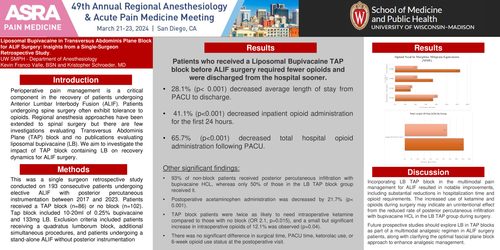
Patients who received a Liposomal Bupivacaine TAP block before ALIF surgery required fewer opioids and were discharged from the hospital sooner.
Other significant findings:
Incorporating LB TAP block in the multimodal pain management for ALIF resulted in notable improvements, including substantial reductions in hospitalization time and opioid requirements. The increased use of ketamine and opioids during surgery may indicate an unintentional effect from the reduced rate of posterior percutaneous infiltration with bupivacaine HCL in the LB TAP group during surgery.
Future prospective studies should explore LB in TAP blocks as part of a multimodal analgesic regimen in ALIF surgery patients, along with clarifying the optimal fascial plane block approach to enhance analgesic management.