457 posters, 2 videos, 2 audios, 8 topics, 45 sessions, 401 authors, 265 institutions
ePostersLive by SciGen Technologies S.A. All rights reserved.
49th Annual Regional Anesthesiology and Acute Pain Medicine Meeting
March 21-23, 2024 | The Hilton Bayfront San Diego | San Diego, California

5510
PROBE-FREE METHOD FOR LONG-LASTING ANALGESIA USING AN INJECTABLE & NEURAL-SELECTIVE ICE SLURRY: COOLING CAPACITY CHARACTERIZATION
Poster Presenter
Authors
Part of Topic
Scientific Abstracts > Emerging Technology
INTRO
•Today’s commercially available cryoneurolysis devices are not simple to use [1]. They require meticulous probe placement to create a perineural ice ball at temperatures between -20⁰C and -100⁰C to incite nerve degeneration.
•Recent published pre-clinical work shows that milder temperature ranges (at -9⁰C) can also reduce myelinated nerve fiber density WHILE sparing unmyelinated nerve fibers & without damage to surrounding skin and muscle tissues [2].
METHODS
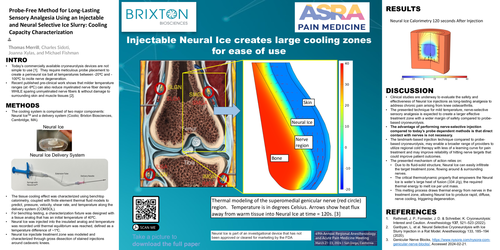
•The cooling system is comprised of two major components: Neural IceTM and a delivery system (Coolio; Brixton Biosciences, Cambridge, MA).
•The tissue cooling effect was characterized using benchtop calorimetry, coupled with finite element thermal fluid models to predict, pressure, velocity, shear rate, and temperature along the delivery system (COMSOL).
•For benchtop testing, a characterization fixture was designed with a tissue analog that has an initial temperature of 40⁰C.
•Neural Ice was injected into the insulated analog and temperature was recorded until thermal equilibrium was reached, defined as a temperature difference of ~1⁰C.
•Neural Ice injectate treatment zone was modeled and characterized through gross dissection of stained injections around cadaveric knees.
DISCUSSION
•Clinical studies are underway to evaluate the safety and effectiveness of Neural Ice injections as long-lasting analgesia to address chronic pain arising from knee osteoarthritis.
•The presented technique for mild temperature, nerve-selective sensory analgesia is expected to create a larger effective treatment zone with a wider margin of safety compared to probe-based cryoneurolysis.
•The advantage of performing nerve-selective injection compared to today’s probe dependent methods is that direct contact with nerves is not necessary.
•The landmark-based injection technique compared to probe-based cryoneurolysis, may enable a broader range of providers to utilize regional cold therapy with less of a learning curve for pain treatment and may improve reliability of hitting nerve targets that could improve patient outcomes.
•The presented mechanism of action relies on:
•Due to its fluid-solid structure, Neural Ice can easily infiltrate the target treatment zone, flowing around & surrounding nerves.
•The critical thermodynamic property that empowers the Neural Ice is water’s large heat of fusion (334 J/g), the required thermal energy to melt ice per unit mass.
•This melting process draws thermal energy from nerves in the treatment zone, allowing Neural Ice to produce rapid, diffuse, nerve cooling, triggering degeneration.
REFERENCES
1.Rathmell, J. P., Forrester, J. D. & Schreiber, K. Cryoneurolysis: Interest and Caution. Anesthesiology 137, 521–523 (2022).
2.Garibyan, L. et al. Neural Selective Cryoneurolysis with Ice Slurry Injection in a Rat Model. Anesthesiology 133, 185–194 (2020).
3.Genicular Nerve Blocks, https://www.nysora.com/nysora-com-genicular-nerve-blocks/, Accessed 2024-02-21.
Neural Ice is part of an investigational device that has not been approved or cleared for marketing by the FDA