457 posters, 2 videos, 2 audios, 8 topics, 45 sessions, 401 authors, 265 institutions
ePostersLive by SciGen Technologies S.A. All rights reserved.
49th Annual Regional Anesthesiology and Acute Pain Medicine Meeting
March 21-23, 2024 | The Hilton Bayfront San Diego | San Diego, California

5180
PERFORMANCE OF AUTOMATED REGIONAL ANESTHESIA FOLLOW-UP AT AN OUTPATIENT SURGERY CENTER
Poster Presenter
Authors
Affiliations
Part of Topic
Scientific Abstracts > Emerging Technology
Performance of automated regional anesthesia follow-up at an outpatient surgery center
Karina Chan, Brittani Bungart, Meredith Pace
Massachusetts General Hospital
Introduction
Follow-up of surgical patients, who have received single shot peripheral nerve blocks or continuous peripheral nerve catheters as part of their anesthetic care, is a way to identify procedure-related complications. While conventional telephone calls have been the traditional follow-up approach, the rates of successful patient contact are relatively low compared to the time burden this system places on clinicians. Peer-reviewed literature on approaches to improving follow-up after single shot peripheral nerve blocks has focused on automated text messaging, email, or mobile phone application-based patient contact [1-3]. In the immediate postoperative period, follow-up with newer technology has yielded improved surgical patient response rates compared to telephone calls [1,2] and was preferred by anesthesia providers [3]. To date, a text message-based, automated follow-up method for patients with continuous peripheral nerve catheters has not been reported. Here, we present our preliminary experience with an automated text messaging system, like the one published by Gessner et al., to provide a consistent regional anesthesia follow-up experience for surgical patients who receive either a single shot peripheral nerve block or a continuous peripheral nerve catheter at Massachusetts General Hospital (MGH) Outpatient Surgical Center (OSC) in Waltham, MA.
Materials and Methods
Massachusetts General Brigham (MGB) IRB approved this study (protocol #2022P000642). Patients who received a regional anesthetic for an ambulatory orthopedic procedure at MGH OSC in Waltham, MA between April 13th, 2022 and December 13th, 2023 were enrolled in automated follow-up if they consented and met the following inclusion criteria: 1) English proficiency, 2) internet access, and 3) ownership of an active email account or mobile phone capable of text messaging. Locations of single shot peripheral nerve blocks and continuous peripheral nerve catheters included mainly the brachial plexus, adductor canal, and sciatic nerve in the popliteal fossa. A web-based record for each enrolled patient was created within the MGB REDCap database. SMS messages containing secure links to identical, secure, online REDCap surveys were sent to patients at two time points: postoperative day 1 (POD1) and postoperative day 4 (POD4), specifically 27 hours and 99 hours after regional anesthetic placement. Each patient received an initial text invitation and a reminder text if they did not complete the survey within 2 hours. Surveys remained accessible to patients for 24 hours after the original text invitation. Data handling was performed using R studio version 2023.06.0. Data was analyzed and plotted in Prism version 9.5.0. Single shot and continuous peripheral nerve catheter demographics were compared using student t-test, with p-value<0.05 considered as statistically significant. Follow-up response rates were analyzed using chi-squared test of independence with post-hoc pairwise comparisons with Bonferonni correction of the p-value (p-value<0.008 for statistical significance).
Results/Case Report
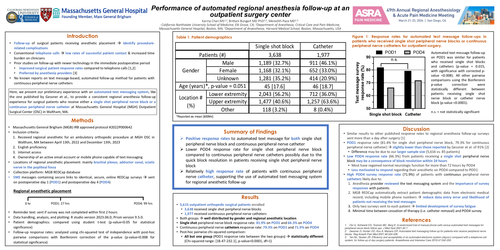
Patient demographics are shown in Table 1 and include 3,638 patients who received single shot peripheral nerve blocks and 1,977 patients who received continuous peripheral nerve catheters. Both groups consist of patients that are well distributed by gender and regional anesthetic location. Patient age between the single shot peripheral nerve block and continuous peripheral nerve catheter groups are found to not be different with means of 45 and 46 years old respectively (p-value=0.051, t=1.954, df=3,851). As shown in Figure 1, the response rates from patients who received a single shot peripheral nerve block are 81.9% on POD1 and 66.3% on POD4. The response rates on POD1 and POD4 from patients with continuous peripheral nerve catheters are 79.3% and 71.9%, respectively. The post-hoc pairwise chi-squared comparison found that all groups are statistically different (Chi-squared range: [18.47- 232.1], p-value<0.0001, df=1). The only exception is the POD1 response rate between single shot peripheral nerve blocks and continuous peripheral nerve catheter groups (p-value=0.015, chi-squared=5.973, df=1).
Discussion
Herein, we present the preliminary results of 5,615 outpatient orthopedic surgical patients who were enrolled in an automated text messaging system for regional anesthetic follow-up. The observed response rates to the automated text message on POD1 from patients who received either a single shot peripheral nerve block or a continuous peripheral nerve catheter (81.4% and 79.3%, respectively) are slightly lower than those reported by Gessner et al. of 91% [2]. This 10% difference may be due to our larger sample size (5,616 compared to 85 patients). The low response rate (66.3%) on POD4 from patients who received a single shot peripheral nerve block may be a consequence of block resolution within 24 hours. By POD4, most of these patients have regained normal neurologic function for more than 72 hours. As a result, patients may feel less motivated to respond to questions about their anesthetic on POD4 compared to POD1. Overall, our results are similar to other published response rates to regional anesthesia follow-up surveys sent more than a day after surgery [1]. In contrast, the POD4 survey response rate of patients with continuous peripheral nerve catheters is relatively high (71.9%). Several elements of our program may have a positive influence on this response rate. Firstly, the anesthesia provider who placed the continuous peripheral nerve catheter reviewed the text messaging system and the importance of survey responses with the patient. Secondly, MGB REDCap is equipped with the ability to automatically extract patient demographic data from the electronic medical record, including mobile phone numbers, reducing data entry error and the likelihood of patients not receiving the text messages. Thirdly, only two surveys are sent to each patient, limiting the development of survey fatigue. Lastly, the time between cessation of therapy (i.e. catheter removal) and the POD4 survey is minimal compared to patients who received regional anesthetics lasting only 24 hours.
References
1. Ooi G, Schwenk ES, Torjman MC, Berg K. A randomized trial of manual phone calls versus automated text messages for peripheral nerve block follow-ups. J Med Syst 2021;45:7.
2. Gessner D, Hunter OO, Kou A, Mariano ER. Automated text messaging follow-up for patients who receive peripheral nerve blocks. Reg Anesth Pain Med 2021;46:524-528.
3. Tan NL, Sestan JR. Efficiency and acceptability of an automated electronic system (daycor) compared with a telephone call system, for follow-up of day surgery patients. Anaesthesia and Intensive Care 2019;47:242-250.