457 posters, 2 videos, 2 audios, 8 topics, 45 sessions, 401 authors, 265 institutions
ePostersLive by SciGen Technologies S.A. All rights reserved.
49th Annual Regional Anesthesiology and Acute Pain Medicine Meeting
March 21-23, 2024 | The Hilton Bayfront San Diego | San Diego, California

5105
PERCUTANEOUS AURICULAR NEUROMODULATION FOR CHOLECYSTECTOMY AND HERNIA REPAIR: A RANDOMIZED, DOUBLE-MASKED, SHAM-CONTROLLED STUDY
Poster Presenter
Authors
Affiliations
Part of Topic
Scientific Abstracts > Emerging Technology
Percutaneous Auricular Neuromodulation for Cholecystectomy and Hernia Repair: A Randomized, Double-Masked, Sham-Controlled Pilot Study
Introduction
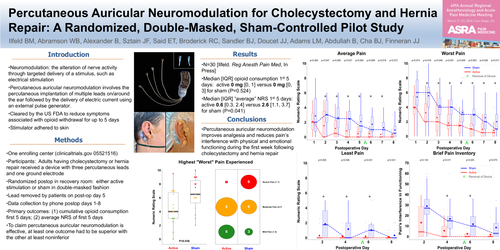
Neuromodulation: the alteration of nerve activity through targeted delivery of a stimulus, such as electrical stimulation. Percutaneous auricular neuromodulation involves the percutaneous implantation of multiple leads on/around the ear followed by the delivery of electric current using an external pulse generator. Cleared by the US FDA to reduce symptoms associated with opioid withdrawal for up to 5 days. Stimulator adhered to skin.
Methods
One enrolling center (clinicaltrials.gov 05521516). Participants: Adults having cholecystectomy or hernia repair received a device with three percutaneous leads and one ground electrode. Randomized postop in recovery room: either active stimulation or sham in double-masked fashion. Lead removed by patients on post-op day 5. Data collection by phone postop days 1-8. Primary outcomes: (1) cumulative opioid consumption first 5 days; (2) average NRS of first 5 days. To claim percutaneous auricular neuromodulation is effective, at least one outcome had to be superior with the other at least noninferior.
Results
N=30 [Ilfeld. Reg Anesth Pain Med, In Press]. Median [IQR] opioid consumption 1st 5 days: active 0 mg [0, 1] versus 0 mg [0, 3] for sham (P=0.524). Median [IQR] “average” NRS 1st 5 days: active 0.6 [0.3, 2.4] versus 2.6 [1.1, 3.7] for sham (P=0.041).
Conclusion
Percutaneous auricular neuromodulation improves analgesia and reduces pain’s interference with physical and emotional functioning during the first week following cholecystectomy and hernia repair.