457 posters, 2 videos, 2 audios, 8 topics, 45 sessions, 401 authors, 265 institutions
ePostersLive by SciGen Technologies S.A. All rights reserved.
49th Annual Regional Anesthesiology and Acute Pain Medicine Meeting
March 21-23, 2024 | The Hilton Bayfront San Diego | San Diego, California

5516
INCORPORATING PHARMACOGENETIC TESTING INTO PERIOPERATIVE PAIN MANAGEMENT TO SUPPORT PERSONALIZED CARE
Poster Presenter
Authors
Affiliations
Part of Topic
Scientific Abstracts > Emerging Technology
Incorporating pharmacogenetic testing into perioperative pain management to support personalized care
Faye Rim MD1,2,3, Benjamin Basseri4, Alexandra Sideris PhD1,2,3, Spencer S Liu MD1,2, Dae Kim MD1, Mary Kelly NP1, Sam Schuessler MHA1, Justas Lauzadis PhD1, Dale J Langford PhD1,2,3
1Department of Anesthesiology, Critical Care & Pain Management, Hospital for Special Surgery, New York, NY; 2Department of Anesthesiology, Weill Cornell Medicine, New York, NY; 3Pain Prevention Research Center at Hospital for Special Surgery, New York, NY; 4Rutgers Robert Wood Johnson Medical School, New Brunswick, NJ
Introduction:
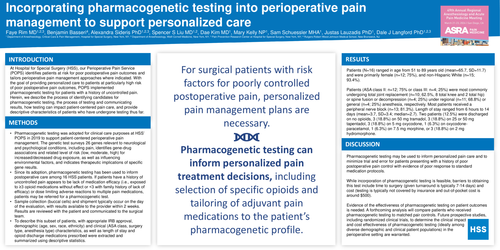
At Hospital for Special Surgery (HSS), our Perioperative Pain Service (POPS) identifies patients at risk for poor postoperative pain outcomes and tailors perioperative pain management approaches where indicated. With the goal of providing personalized care to patients at particularly high risk of poor postoperative pain outcomes, POPS implemented pharmacogenetic testing for patients with a history of uncontrolled pain. Herein, we describe the process of identifying candidates for pharmacogenetic testing, the process of testing and communicating results, how testing can impact patient-centered pain care, and provide descriptive characteristics of patients who have undergone testing thus far.
Methods:
Patients (N=16) ranged in age from 51 to 89 years old (mean=65.7, SD=11.7) and were primarily female (n=12; 75%), and non-Hispanic White (n=15; 93.4%). Patients (ASA class II: n=12; 75% or class III: n=4; 25%) were most commonly undergoing total joint replacement (n=10; 62.5%, 8 total knee and 2 total hip) or spine fusion or decompression (n=4; 25%) under regional (n=11; 68.8%) or general (n=4; 25%) anesthesia, respectively. Most patients received a peripheral nerve block (n=13; 81.3%). Length of stay ranged from 6 hours to 14 days (mean=3.7, SD=3.4; median=2.7). Two patients (12.5%) were discharged on no opioids, 3 (18.8%) on 50 mg tramadol, 3 (18.8%) on 25 or 50 mg tapentadol, 3 (18.8%) on 5 mg oxycodone, 1 (6.3%) on oxycodone-paracetamol, 1 (6.3%) on 7.5 mg morphine, or 3 (18.8%) on 2 mg hydromorphone.
Discussion:
Pharmacogenetic testing may be used to inform personalized pain care and to minimize trial and error for patients presenting with a history of poor postoperative pain control with evidence of poor response to standard medication protocols. While incorporation of pharmacogenetic testing is feasible, barriers to obtaining this test include time to surgery (given turnaround is typically 7-14 days) and cost (testing is typically not covered by insurance and out-of-pocket cost is around $500). Evidence of the effectiveness of pharmacogenetic testing on patient outcomes is needed. A forthcoming analysis will compare patients who received pharmacogenetic testing to matched pair controls. Future prospective studies, including randomized clinical trials, to determine the clinical impact and cost effectiveness of pharmacogenetic testing (ideally among diverse demographic and clinical patient populations) in the perioperative setting are warranted.