457 posters, 2 videos, 2 audios, 8 topics, 45 sessions, 401 authors, 265 institutions
ePostersLive by SciGen Technologies S.A. All rights reserved.
49th Annual Regional Anesthesiology and Acute Pain Medicine Meeting
March 21-23, 2024 | The Hilton Bayfront San Diego | San Diego, California

5106
PULSED SHORTWAVE THERAPY TO TREAT POSTAMPUTATION PAIN: A RANDOMIZED, DOUBLE-MASKED, SHAM-CONTROLLED, CROSSOVER PILOT STUDY
Poster Presenter
Authors
Affiliations
Part of Topic
Scientific Abstracts > Emerging Technology
Pulsed Shortwave Therapy to Treat Postamputation Pain: A Randomized, Double-Masked, Sham-Controlled, Crossover Pilot Study
Introduction
Postamputation phantom and residual limb pain are difficult to treat.. Ultrasound-guided continuous peripheral nerve blocks and percutaneous peripheral nerve stimulation have had limited success. Pulsed shortwave therapy has been used for over 7 decades to treat chronic and acute pain conditions, decrease postoperative inflammation and edema, and hasten bone regeneration and wound healing. Initially, devices were large and bulky, but modern advancements have led to portable, lightweight, battery-operated, single-use, wearable devices cleared by the FDA.
Methods
One enrolling center (clinicaltrials.gov 05392803 ). Participants: Adults with a lower limb amputation and daily phantom and/or residual limb pain. Stimulator adhered to around the distal end of their residual limb or positioned at the end of the limb. Randomized to 28 days of either active stimulation or sham in double-masked fashion. Lead applied and removed by patients at home followed by a crossover treatment beginning on day 35. Primary outcomes: (1) change in "average" residual and phantom limb pain scores between baseline and Day 28 using the Numeric Rating Scale; (2) and the Patient Global Impression of Change on Day 28.
Results
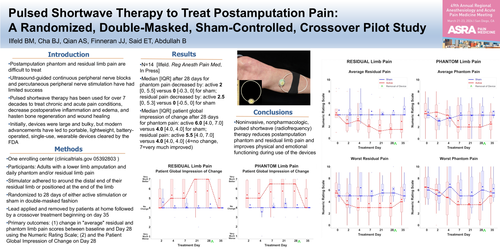
N=14 [Ilfeld. Reg Anesth Pain Med, In Press]. Median [IQR] after 28 days for phantom pain decreased by: active 2 [0, 5.5] versus 0 [-0.3, 0] for sham; residual pain decreased by: active 2.5 [0, 5.3] versus 0 [-0.5, 0] for sham. Median [IQR] patient global impression of change after 28 days for phantom pain: active 6.0 [4.0, 7.0] versus 4.0 [4.0, 4.0] for sham; residual pain: active 5.5 [4.0, 7.0] versus 4.0 [4.0, 4.0] (4=no change, 7=very much improved).
Conclusions
Noninvasive, nonpharmacologic, pulsed shortwave (radiofrequency) therapy reduces postamputation phantom and residual limb pain and improves physical and emotional functioning during use of the devices