457 posters, 2 videos, 2 audios, 8 topics, 45 sessions, 401 authors, 265 institutions
ePostersLive by SciGen Technologies S.A. All rights reserved.
49th Annual Regional Anesthesiology and Acute Pain Medicine Meeting
March 21-23, 2024 | The Hilton Bayfront San Diego | San Diego, California

5405
DIVERSITY OF REGIONAL ANESTHESIOLOGY AND ACUTE PAIN MEDICINE TRAINEES AND FACULTY: AN ANALYSIS OF FELLOWSHIPS FROM 2016–2023
Poster Presenter
Authors
Affiliations
Part of Topic
Scientific Abstracts > Education
-
Females comprise approximately 26.1% of practicing anesthesiologists and 19.6% of pain medicine physicians.1
-
Anesthesiologists and pain physicians are also predominantly white, comprising 68.7% and 52.9% of active physicians, respectively.1
-
Since the ACGME began accrediting regional anesthesiology/acute pain (RA/AP) fellowships in 2016, no study has yet examined the diversity of RA/AP training programs.
-
We aimed to examine the gender and racial diversity in ACGME-accredited RA/AP fellowship programs from 2016-2023.
-
The ACGME website was accessed to identify ACGME-accredited RA/AP fellowship programs as of December 2023.
-
Each program website was accessed to determine the gender of the fellowship program director (PD) gender, division chief, and anesthesiology department chair.
-
ACGME’s Graduate Medical Education Data Resource Book for the years 2016-2023 was accessed for anesthesiology residents’, pain medicine fellows’, and RA/AP fellows’ sex and race/ethnicity. Data on total number of trainees and training programs available was also abstracted for each year.
-
The U.S. Census website was accessed for their population estimates of the proportion of the US population identifying as Black and Hispanic.
-
AAMC’s Annual Report on Residents was accessed for data on recently graduated fellows working in medically underserved areas (MUAs) in 2022.
-
Two-sample tests of proportions and odds ratio testing were performed.
-
The threshold for significance was set at p<0.05 for two-tailed p-values. SPSS (IRB Corp., Armonk, NY) was used for all statistical analysis.
-
Study was exempt from IRB review requirements as per Rutgers University policy.
-
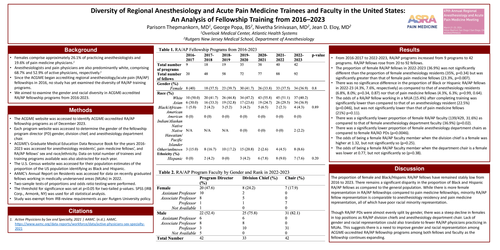
From 2016-2017 to 2022-2023, RA/AP programs increased from 9 programs to 42 programs. RA/AP fellows rose from 20 to 92 fellows.
-
The proportion of female RA/AP fellows in 2022-2023 (36.9%) was not significantly different than the proportion of female anesthesiology residents (35%, p=0.34) but was significantly greater than that of female pain medicine fellows (23.3%, p=0.007).
-
There was no significance difference in the proportion of Black or Hispanic RA/AP fellows in 2022-23 (4.3%, 7.6%, respectively) as compared to that of anesthesiology residents (6.8%, 8.0%; p=0.34, 0.87) nor that of pain medicine fellows (4.3%, 6.3%; p=0.99, 0.64).
-
The odds of a RA/AP fellow working in a MUA (15.4%) after completing training was significantly lower than compared to that of an anesthesiology resident (22.5%) (p=0.046), but was not significantly lower than that of pain medicine fellows (21%) p=0.11).
-
There was a significantly lower proportion of female RA/AP faculty (139/429, 31.6%) as compared to that of female anesthesiology department faculty (36.9%) (p=0.02).
-
There was a significantly lower proportion of female anesthesiology department chairs as compared to female RA/AD PDs (p=0.0046).
-
The odds of being a female RA/AP faculty member when the division chief is a female was higher at 1.32, but not significantly so (p=0.25).
-
The odds of being a female RA/AP faculty member when the department chair is a female was lower at 0.77, but not significantly so (p=0.38).
- The proportion of female and Black/Hispanic RA/AP fellows have remained stably low from 2016 to 2023. There remains a significant disparity in the proportion of Black and Hispanic RA/AP fellows as compared to the general population. While there is more female representation in RA/AP fellowships compared to pain medicine fellowships, minority RA/AP fellow representation is comparable to anesthesiology residency and pain medicine representation, all of which have poor racial minority representation.
-
Though RA/AP PDs were almost evenly split by gender, there was a steep decline in females in top positions as RA/AP division chiefs and anesthesiology department chair. Lack of gender and racial representation could also translate to fewer RA/AP physicians practicing in MUAs. This suggests there is a need to improve gender and racial representation among ACGME-accredited RA/AP fellowship programs among both fellows and faculty as the fellowship continues expanding.