457 posters, 2 videos, 2 audios, 8 topics, 45 sessions, 401 authors, 265 institutions
ePostersLive by SciGen Technologies S.A. All rights reserved.
49th Annual Regional Anesthesiology and Acute Pain Medicine Meeting
March 21-23, 2024 | The Hilton Bayfront San Diego | San Diego, California

5266
CURRICULUM DESIGN FOR VIRTUAL REALITY BASED TEACHING OF NEURAXIAL ANESTHESIA
Poster Presenter
Authors
Affiliations
Part of Topic
Scientific Abstracts > Education
Title: Curriculum Design for Virtual Reality Based Teaching of Neuraxial Anesthesia
Background
-
Virtual Reality (VR) is growing field within medical education [1], actively being explored in anesthesiology education [2]
-
There is a need within graduate medical anesthesiology training to improve upon education within regional/acute and chronic interventional pain [3]
-
Survey data demonstrates that approximately 20-25% of anesthesiology residents were only “somewhat” or “not” satisfied with their residency training with regard to certain pain procedures [4]
-
Anesthesia residents at NewYork Presbyterian/Weill Cornell are required to complete at minimum a one month Regional Anesthesia and Pain Medicine (RAPM) rotation
-
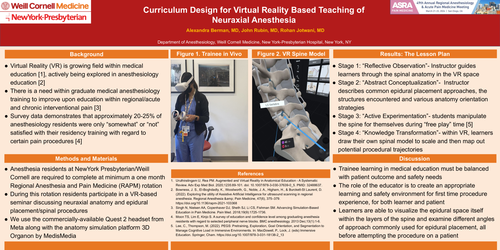
During this rotation residents participate in a VR-based seminar discussing neuraxial anatomy and epidural placement/spinal procedures
-
We use the commercially-available Quest 2 headset from Meta along with the anatomy simulation platform 3D Organon by MedisMedia
-
Stage 1: “Reflective Observation”- Instructor guides learners through the spinal anatomy in the VR space
-
Stage 2: “Abstract Conceptualization”- Instructor describes common epidural placement approaches, the structures encountered and various anatomy orientation strategies
-
Stage 3: “Active Experimentation”- students manipulate the spine for themselves during “free play” time [5]
-
Stage 4: “Knowledge Transformation”- within VR, learners draw their own spinal model to scale and then map out potential procedural trajectories
-
Trainee learning in medical education must be balanced with patient outcome and safety needs
-
The role of the educator is to create an appropriate learning and safety environment for first time procedure experience, for both learner and patient
-
Learners are able to visualize the epidural space itself within the layers of the spine and examine different angles of approach commonly used for epidural placement, all before attempting the procedure on a patient