Loading...

457 posters, 2 videos, 2 audios, 8 topics, 45 sessions, 401 authors, 265 institutions

ePostersLive by SciGen Technologies S.A. All rights reserved.

49th Annual Regional Anesthesiology and Acute Pain Medicine Meeting

March 21-23, 2024 | The Hilton Bayfront San Diego | San Diego, California

49th Annual Regional Anesthesiology and Acute Pain Medicine Meeting banner

5294

THE EFFECT OF PERIOPERATIVE OPIOID EDUCATION ON OUTCOMES AFTER TOTAL KNEE ARTHROPLASTY: A RANDOMIZED CONTROLLED PILOT STUDY
Part of Topic

Scientific Abstracts > Education

The effect of perioperative opioid education on outcomes after total knee arthroplasty: a randomized controlled pilot study.

Miriam Sheetz, B.S.1, Angela Puglisi, B.S.1, Pa Thor, Ph.D.1, Justas Lauzadis, Ph.D.1,4, Mark Trentalange, M.D.1,5, Marko Popovic, B.S 1, Maya Tailor, B.A.1, Julia Reichel, B.S.1, Haoyan Zhong, M.S.1, Alex Illescas, MPH 1, Jiabin Liu, M.D.1, 4, Christopher Wu, M.D.1, 4, Kanupriya Kumar, M.D.1, 4, William Qiao, M.D.1, 4, Stephanie Cheng, M.D. 1,3,4, Kethy Jules-Elysee, M.D.1,4, David Kim, M.D.1, 4, Sang Kim, M.D.1, 4, Yi Lin, M.D.1, 4, Daniel Maalouf, M.D.1,4, Fay Rim, M.D.1, 4, Ellen Soffin, M.D.1, 4, Christopher Tanaka, M.D.1, 4, Uchenna Umeh, M.D. 1, 4, Seth Waldman, M.D.1, 4, Pamela Wendel, M.D.1, 4, Brian Chalmers, M.D.2, Alejandro Gonzalez Della Valle, M.D.2, Elizabeth Gausden, M.D.2, Jason Blevins, M.D.2, Michael Ast, M.D.2, Ph.D., David Mayman, M.D.2, Peter Sculco, M.D.2, Alexander McLawhorn, M.D., MBA 2, Patricia Quinlan, Ph.D., MPA, CPHQ 6, Alexandra Sideris, Ph.D.1, 3, 4, Bradley Lee, M.D.1, 4

1Department of Anesthesiology, Critical Care & Pain Management, Hospital for Special Surgery, New York, NY, 2Department of Orthopedic Surgery, Adult Reconstruction and Joint Replacement Surgery, Hospital for Special Surgery, New York, NY, 3Pain Prevention Research Center, Hospital for Special Surgery, New York, NY, 4Department of Anesthesiology, Weil Cornell Medicine, New York, NY, 5Department of Anesthesiology, James J. Peters VA Medical Center, 6Department of Nursing, Hospital for Special Surgery, New York, NY


Introduction

•Patients undergoing total knee arthroplasty (TKA) experience significant postoperative pain requiring opioids, yet often lack knowledge regarding appropriate dosage and handling of medications. Evidence suggests that educational interventions in various formats may assist in promoting proper usage and improving postoperative pain control 1-4.
•The aim of this study is to assess the feasibility of two novel educational pathways:
     1.In-person educations + PDF handouts
     2.Video education + PDF handouts
•The education intervention focused specifically on opioids and pain control. Our study also aimed to evaluate how these education pathways compare with the current education provided to patients at our hospital
 
 
Methods

A total of 42 patients undergoing TKA were enrolled. Patients were randomized to 1 of 3 groups:

1.Control: Patient attends the current HSS preoperative webinar lasting approximately 50 minutes covering various topics including a segment on opioids and postoperative pain management.
2.In-person education: Patient receives an approximately 9-minute session conducted in-person by a research staff member reading a script detailing proper opioid use and handling, side effects and risks, and opioid dosing and weaning strategies. Each patient also receives a PDF handout to take home. Intervention is administered in the preoperative holding area and repeated on POD 1.
3.Video education: Patient watches a 9-minute video with the same content as the in-person session which reviews opioids and pain management. Each patient also receives the PDF handout to take home. Intervention is administered in the preoperative holding area and repeated on POD 1.

All patients received the same anesthesia protocol and were discharged with 42 tabs of oxycodone.


Results

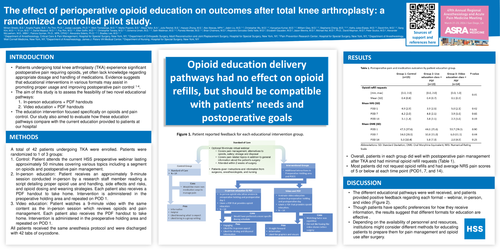
•Overall, patients in each group did well with postoperative pain management after TKA and had minimal opioid refill requests (Table 1).
•Most patients did not request opioid refills and had average NRS pain scores of 5 or below at each time point (POD1, 7, and 14).
 
 
Discussion
 
•The different educational pathways were well received, and patients provided positive feedback regarding each format – webinar, in-person, and video (Figure 2).
•Though patients have specific preferences for how they receive information, the results suggest that different formats for education are effective .
•Depending on the availability of personnel and resources, institutions might consider different methods for educating patients to prepare them for pain management and opioid use after surgery.
 

Opioid education delivery pathways had no effect on opioid refills, but should be compatible with patients’ needs and postoperative goals.

49th Annual Regional Anesthesiology and Acute Pain Medicine Meeting » banner
Copyright © 2015-2026, ePostersLive® SciGen is a registered trademark of SciGen Technologies S.A. Patent pending.

This website and third-party tools we use rely on cookies for the best user experience. By selecting "I agree", you agree to cookie usage as described in our Privacy Policy.