457 posters, 2 videos, 2 audios, 8 topics, 45 sessions, 401 authors, 265 institutions
ePostersLive by SciGen Technologies S.A. All rights reserved.
49th Annual Regional Anesthesiology and Acute Pain Medicine Meeting
March 21-23, 2024 | The Hilton Bayfront San Diego | San Diego, California

5483
THE READABILITY OF ONLINE ENGLISH AND SPANISH PATIENT EDUCATION MATERIALS ON ORTHOPEDIC ANESTHESIA.
Poster Presenter
Authors
Affiliations
Part of Topic
Scientific Abstracts > Education
Background
•With most orthopedic surgeries amenable to various anesthetic options, related online patient education materials (PEMs) should be easily retrievable, comprehensive, and readable by the general population.
•PEMs written at a higher than recommended reading level limit patients’ access to crucial health information.
•Multiple federal agencies currently recommend that PEMs be written at a 6th to 8th grade reading level to be adequately understood by patients.
•Language barriers represent an additional complexity in terms of the accessibility of PEMs.
•This study describes and compares the readability levels of online PEMs available in English and Spanish for anesthesia related to orthopedic surgeries, with a focus on total hip, knee and shoulder joint replacement.
Methods
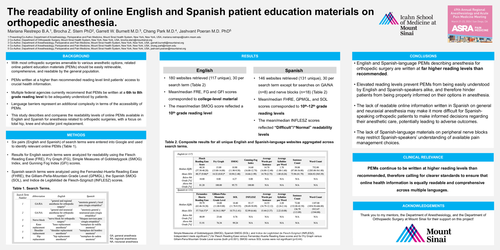
•Six pairs (English and Spanish) of search terms were entered into Google and used to identify relevant online PEMs (Table 1).
•Results for English search terms were analyzed for readability using the Flesch Reading Ease (FRE), Fry Graph (FG), Simple Measures of Gobbledygook (SMOG) Index, and Gunning Fog Index (GFI) scores.
•Spanish search terms were analyzed using the Fernandez-Huerta Reading Ease (FHRE), the Gilliam-Peña-Mountain Grade Level (GPMGL), the Spanish SMOG (SOL), and Indice de Legibilidad de Flesch-Szigriszt(INFLESZ) scores.
Results
English
•180 websites retrieved (117 unique), 30 per search term (Table 2)
•Mean/median FRE, FG and GFI scores corresponded to college-level material
•The mean/median SMOG score reflected a 10th grade reading level
Spanish
•146 websites retrieved (131 unique), 30 per search term except for searches on GA/NA (n=8) and nerve blocks (n=18) (Table 2)
•Mean/median FHRE, GPMGL, and SOL scores corresponded to 10th-12thgrade reading levels
•The mean/median INFLESZ scores reflected “Difficult”/“Normal” readability levels
Conclusions
•English and Spanish-language PEMs describing anesthesia for orthopedic surgery are written at far higher reading levels than recommended.
•Elevated reading levels prevent PEMs from being easily understood by English and Spanish-speakers alike, and therefore hinder patients from being properly informed on their options in anesthesia.
•The lack of readable online information written in Spanish on general and neuraxial anesthesia may make it more difficult for Spanish-speaking orthopedic patients to make informed decisions regarding their anesthetic care, potentially leading to adverse outcomes.
•The lack of Spanish-language materials on peripheral nerve blocks may restrict Spanish-speakers’ understanding of available pain management choices.
Clinical Relevance
PEMs continue to be written at higher reading levels than recommended, therefore calling for clearer standards to ensure that online health information is equally readable and comprehensive across multiple languages.