457 posters, 2 videos, 2 audios, 8 topics, 45 sessions, 401 authors, 265 institutions
ePostersLive by SciGen Technologies S.A. All rights reserved.
49th Annual Regional Anesthesiology and Acute Pain Medicine Meeting
March 21-23, 2024 | The Hilton Bayfront San Diego | San Diego, California

5236
USING A HANDS-ON CADAVER LAB TO TRAIN SENIOR ANESTHESIOLOGY RESIDENTS FOR NEURAXIAL PROCEDURES IN THE LATERAL DECUBITUS POSITION
Poster Presenter
Authors
Affiliations
Part of Topic
Scientific Abstracts > Education
- Title: Using a hands-on cadaver workshop to train senior anesthesiology residents for challenging neuraxial procedures in the lateral decubitus position
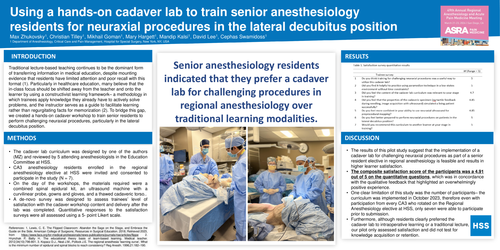
Traditional lecture-based teaching continues to be the dominant form of transferring information in medical education, despite mounting evidence that residents have limited attention and poor recall with this format (1). Particularly in healthcare education, many believe that the in-class focus should be shifted away from the teacher and onto the learner by using a constructivist learning framework– a methodology in which trainees apply knowledge they already have to actively solve problems, and the instructor serves as a guide to facilitate learning rather than regurgitating facts for memorization (2). To bridge this gap, we created a hands-on cadaver workshop to train senior residents to perform challenging neuraxial procedures, particularly in the lateral decubitus position.
The cadaver lab curriculum was designed by one of the authors (MZ) and reviewed by 5 attending anesthesiologists in the Education Committee at HSS. CA3 anesthesiology residents enrolled in the regional anesthesiology elective at HSS were invited and consented to participate in the study (N = 7). On the day of the workshops, the materials required are a combined spinal epidural kit, an ultrasound machine with a curvilinear probe, gowns and gloves, and a thawed cadaveric torso. A de-novo survey was designed to assess trainees’ level of satisfaction with the cadaver workshop content and delivery after the lab was completed. Quantitative responses to the satisfaction surveys were all assessed using a 5-point Likert scale.
The results of this pilot study suggest that the implementation of a cadaver lab for challenging neuraxial procedures as part of a senior resident elective in regional anesthesiology is feasible and results in higher learner satisfaction. The composite satisfaction score of the participants was a 4.91 out of 5 on the quantitative questions, which was in concordance with the qualitative feedback that highlighted an overwhelmingly positive experience (Table 1). One clear limitation of this study was the number of participants– the curriculum was implemented in October 2023, therefore even with participation from every CA3 who rotated on the Regional Anesthesiology elective at HSS, only seven were able to participate prior to submission. Furthermore, although residents clearly preferred the cadaver lab to intraoperative learning or a traditional lecture, our pilot only assessed satisfaction and did not test for knowledge acquisition or retention.